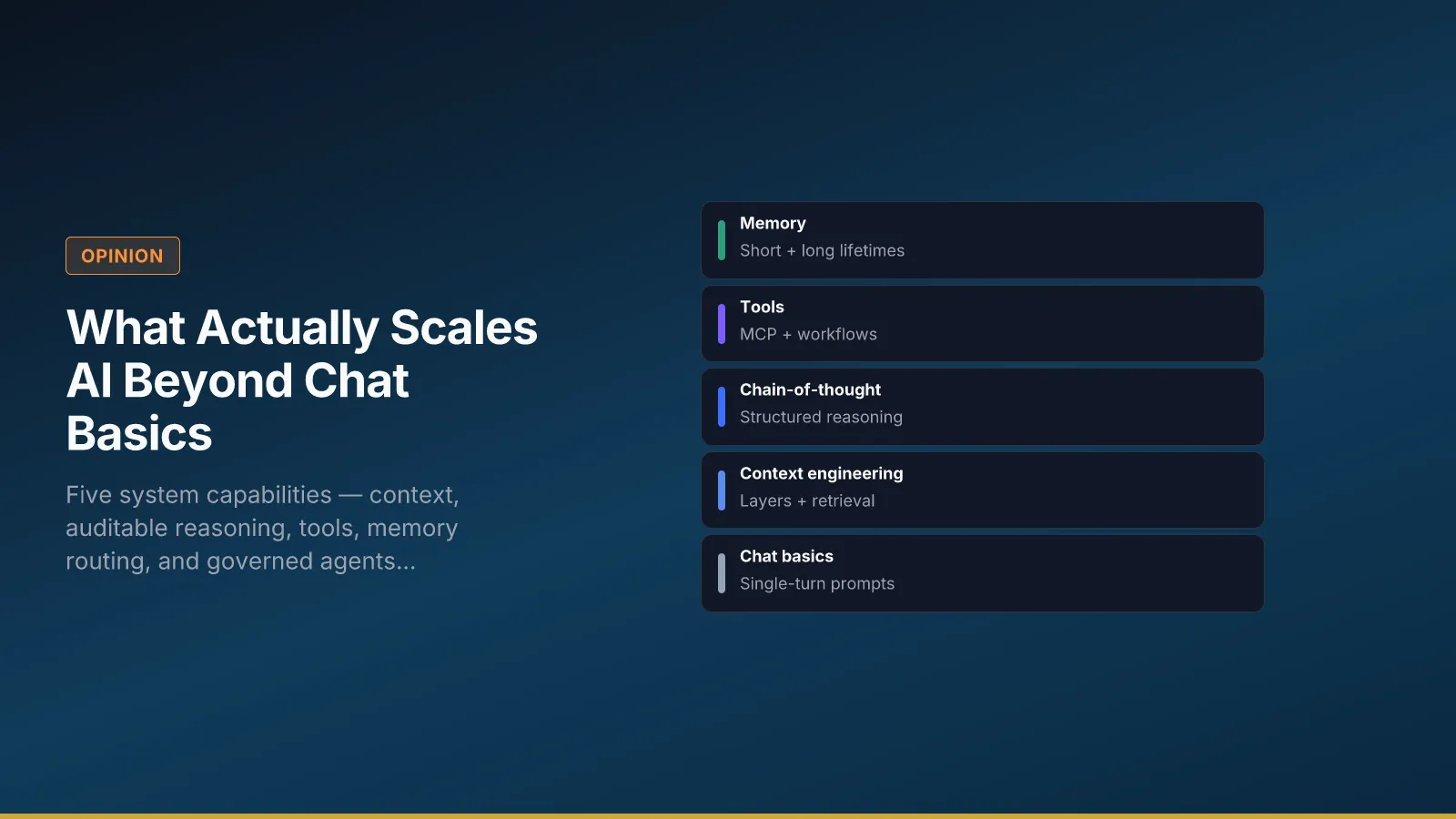
Teams celebrate “AI adoption” when license counts rise and workshop attendance spikes. Pilots still fail because nobody can name which system capability was missing — only that “the model wasn’t good enough.” The five blocks on the hero — context engineering, chain-of-thought, tool use, memory, and agents — are not a certification ladder. They are promotion decisions that require evidence, owners, and eval gates before production traffic.
Primer — for maturity framing see AI Implementation Maturity Ladder.
Northline B2B learned this during support-reply-v3: executives wanted agent branding after a strong demo week. Ops refused tool access until context packs were versioned, memory was scoped to ticket threads only, and eval pass held above ninety-two percent across thirty cases. The delay felt slow; the alternative was autonomy without replay when Legal asked what was sent to a customer.
Context engineering
“Better messages” is not context engineering. Engineering means deciding what the model may see, in what order, under which policy version — before anyone writes a clever prompt. Chat threads that grow forever are the opposite of engineering: they mix stale policy, ad hoc rules, and tribal prompt edits with no version ID.
Northline’s first failure mode was exporting entire ticket histories into every draft. Pass rate looked fine on short threads; on tier-two cases with attachments, citations thinned and refund language drifted. The fix was a scoped context pack — approved macros, current policy version, CRM fields on an allow list — designed like an API contract. Scale started when Legal could approve context-pack-v4 and ops could replay a run with the same pack hash.
Promotion criterion: named context pack owner, version in registry, smoke eval on pack change. See What Is Context Architecture for layer design and Prompt Registry Playbook for release discipline.
Chain-of-thought (when it belongs)
Step-by-step reasoning helps auditable tasks — math checks, multi-clause contract review, structured extraction where each step must appear in output. It is not mandatory wallpaper on every request. Over-prompting reasoning slows latency, increases token cost, and invites performative “thinking” text customers never needed.
Northline added explicit CoT only on pricing-tier verification — a step where wrong tier shipped twice in pilot. Held-out eval showed a six-point pass-rate lift when reasoning was scoped to that subtask; adding CoT to every reply added latency without measurable quality gain. They split steps: retrieval and draft on one call, tier check on a second with low temperature and a fixed output schema.
Promotion criterion: CoT limited to steps with documented failure cost; eval compares with/without on held-out set; latency impact recorded on the workflow canvas.
Tool use
Tools extend the model into systems of record — CRM, search, ticketing, send gates. Scale requires allow lists, rate limits, and human approval on external actions — not “give the model internet.” Every connector is a new data path auditors will ask about.
Northline blocked CRM write access in v1. Read-only ticket lookup and approved macro retrieval were enough for assist; send stayed human-gated. When they added a calendar lookup tool, data boundaries documented which fields could enter context and which required redaction — see Data Boundaries for AI Agents.
Promotion criterion: tool allow list published, rate limits set, no external send without human gate, audit fields for tool calls. Full design path: How to Design an AI Agent Workflow.
Memory
Memory is not “remember everything.” It is routing: what persists, who may read it, how it is deleted. Confusing chat history with organizational memory creates retention risk and inconsistent answers across channels.
Northline scoped assistant memory to ticket thread context only, with explicit TTL and no cross-customer profile blending, before expanding to renewal workflows. Profile facts required consent paths and deletion on churn — not silent accumulation in a shared copilot sidebar.
Promotion criterion: TTL and access controls per memory type; no session state as policy record. Primer: Three Types of AI Memory; production patterns: Memory Types for AI Systems.
Agents
Agents are orchestrated steps with boundaries, not autonomous hype. Multi-step autonomy without eval gates and audit trails is a liability — especially when vendors label every template “agent.”
Promotion along the ladder should require evidence, not executive enthusiasm. Northline ties each agent capability to risk-forum votes and changelog entries so “we shipped an agent” means a bounded workflow with handoffs, not a feature flag on chat. Multi-specialist flows need explicit contracts: Multi-Agent Handoff Pattern.
Promotion criterion: eval pass stable thirty days, boundaries enforced, audit trails populated — Audit Trails for AI Workflows, hooks in Evaluation Hooks for AI Workflows.
Promotion checklist
Copy this table into your workflow wiki. If a row cannot be filled, do not expand scope — fix the gap first.
| Capability | Evidence required | Owner |
|---|---|---|
| Context engineering | Versioned context pack + smoke eval on change | Process + IT |
| Chain-of-thought | Held-out lift on scoped step; latency documented | Quality lead |
| Tool use | Allow list, rate limits, no unapproved send | IT + process owner |
| Memory | TTL, access matrix, deletion path | Privacy + product |
| Agents | 30-case pass rate, audit fields, forum approval | Governance sponsor |
When NOT to scale
Three anti-patterns recur when teams skip evidence:
- License scaling — buying seats or window size when pass rate is flat and overrides are rising.
- Hero prompting as production — power users produce demos that cannot survive handoff to the next shift.
- Agent branding before boundaries — autonomy labels on chat without tool allow lists or replay logs.
Scaling is an operating decision. The Model Is Not the System frames the wrapper; AI Risk Review Cadence keeps changes from shipping on enthusiasm alone.