Audit trails turn AI from a black box into an accountable process. Regulators, customers, and your own teams ask the same questions after a near-miss: what was sent, on what basis, which policy version applied, and who approved it? If answers require reconstructing someone’s chat history, you have a demo—not a workflow ready for scale.
Northline B2B logs every support-reply-v3 run. This article lists minimum fields, explains why each matters, provides a sample JSON row for ticket #4821, and connects retention and review cadence to governance roles and risk review. Prompt text in a wiki is not proof; logs with hashes and versions are. When retrieval tiers change, align logging with the pattern in Three Types of RAG.
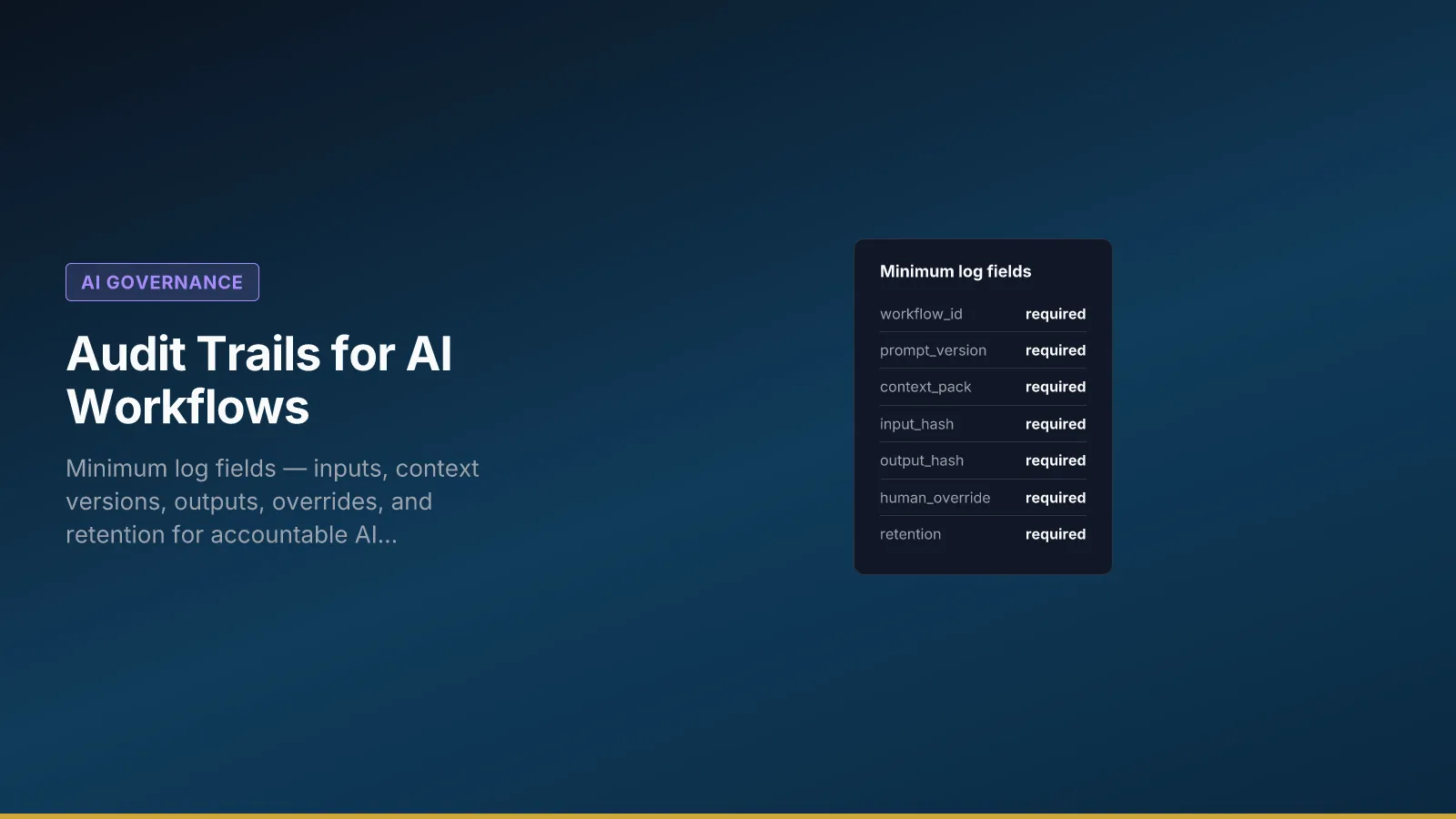
Minimum log fields (design once, enforce in IT)
Compare your current logs to this set before buying another observability tool. Gaps here are gaps in accountability.
| Field | Why it matters |
|---|---|
| Workflow ID + version | Reproduce behavior after prompt or context changes |
| User / service identity | Accountability for human vs automated actors |
| Input snapshot or hash | Evidence of what the model saw without storing excess PII |
| Context sources retrieved | Explainability when output cites or implies facts |
| Model + parameters | Regression analysis when vendors update |
| Raw model output | Compare to what was actually sent |
| Human override flag | Prove review happened before customer-facing send |
| Timestamp (UTC) | Ordering across CRM, ticket, and log systems |
| Policy / context pack version | Tie language to Legal-approved library state |
Northline added policy_pack_version after a near-miss discussed in risk forum—plan for schema evolution in your registry, not as a one-off firefight. Required fields do not differ for MCP versus custom connectors; the MCP vs custom tool APIs playbook keeps the same minimum on both surfaces.
Optional but valuable: checker_result, eval_gate (smoke/pilot/prod), boundary_denied events, template_hash from structured prompt system.
Sample log row (ticket #4821)
The JSON below is representative of a governed assist run—use it in replay drills with process owners and Legal.
{
  "workflow_id": "support-reply-v3",
  "workflow_version": "1.4.2",
  "case_id": "4821",
  "timestamp_utc": "2026-05-14T15:22:08Z",
  "actor_id": "agent:jsmith",
  "model": "gpt-4.1-mini",
  "policy_pack_version": "support-policy-2026-04",
  "context_sources": ["KB-K-104", "KB-K-207", "ticket:4821:msgs:1-5"],
  "input_hash": "sha256:9f3a…",
  "raw_output": "Thank you for contacting Northline…",
  "sent_text": "Thank you for contacting Northline regarding your invoice…",
  "human_override": true,
  "override_reason": "tone_softening",
  "eval_gate": "pilot",
  "retention_class": "compliance_7y"
}
Reviewers confirmed the agent edited before send, policy pack matched active legal library, and retrieved KB IDs were customer-safe tags only—aligned with data boundaries. Without sent_text vs raw_output, override discipline is invisible.
Retention and storage classes
Do not invent a shorter window for “AI logs” if customer contracts require seven years for support correspondence. Align AI audit classes with existing records policy—Legal owns the mapping, IT implements immutability where required.
Compliance logs — durable, access-controlled, indexed by workflow_id and case_id. Northline: seven years per contract.
Debug logs — verbose prompts, retrieval traces; shorter TTL (e.g., thirty days). Never the only evidence for customer sends.
Separate classes prevent cost-driven deletion of evidence you will need in a dispute. Document retention in the same wiki page as the context spec in context architecture.
Review cadence tied to logs
Logging without review is storage expense. Monthly, process owners sample high-risk cases—overrides, VIP flags, checker failures. After every prompt or policy pack change, spot-check ten cases against evaluation hooks pass artifacts.
Stable row-level history must exist before aggregate dashboards mean anything—see Critique Agent v0.9 for a local stack that persisted audit rows before shipping /audit_stats, Critique Agent v1.0 for validate-before-persist on a local CLI stack, and Part 3 for a cross-repo field test where valid rows still required human triage.
Replay drills quarterly: pick a ticket ID, reconstruct from logs alone, compare to ground truth in CRM. If drill fails, forum action owns schema fix—not “train agents better.”
Northline links drill results to forum minutes; failed drills block shadow traffic increases until IT closes gaps.
Operating audit trails in practice
Store hash of inputs when full snapshot is too large—but keep retrieval IDs so humans can rebuild context. Index logs for common incident queries: workflow version changes on a date range, overrides by reason code, boundary_denied spikes.
When integrators add tools, extend schema before launch—retrofit is painful under audit pressure. Include denial events even when no model call occurred; they prove boundaries work.
Monday start: Gap-analysis workshop—nine minimum fields vs current export. One replay drill on a real or synthetic case. Add policy_pack_version or equivalent before the next context change ships.
If you cannot reconstruct a case from logs, pause promotion until you can. Accountability is the product—not the model summary.