Companies rarely fail at AI because the model is weak. They fail because the system around the model—workflow, context, evaluation, and governance—is undefined. Executives see fast demos in a chat window and assume the interface is the product. Operations then inherit inconsistent outputs, duplicate tools, and reviews that start only after a customer or regulator notices a problem.
Chat-only AI feels like progress because the first draft is instant. That speed hides what production actually requires: known inputs, repeatable steps, measurable quality, and named owners when something goes wrong. Without that wrapper, every “successful” pilot is a one-off performance—not an implementation discipline your org can run next quarter.
If your team is still debating which model to buy while nobody owns the workflow, you are optimizing the wrong layer. The sections below define what a system includes, what breaks when you skip it, and how to move from demo to a bounded pilot in thirty days. Key terms: Glossary.
The model is one component
A language model generates text from patterns in data. It does not own your process, your data boundaries, or your quality bar. It does not know which CRM record is authoritative, which clause Legal approved last month, or which pricing tier applies to a given region unless you engineer context and enforce workflow around the call.
Treating the chat window as the product trains the organization to equate access with advantage. Everyone gets the same model; differentiation comes from how you scope tasks, attach approved context, review outputs, and log changes. When teams skip that layer, they get impressive drafts and fragile operations—exactly the pattern described in 10 Signs Your Company Is Vibe Prompting.
Anti-pattern: “We rolled out copilots; adoption is high, so we are done.” High adoption without a defined outcome, evaluation set, and owner is activity, not a system. Better question: For our highest-risk workflow, what must be true before a model output reaches a customer or regulator?
What a system includes
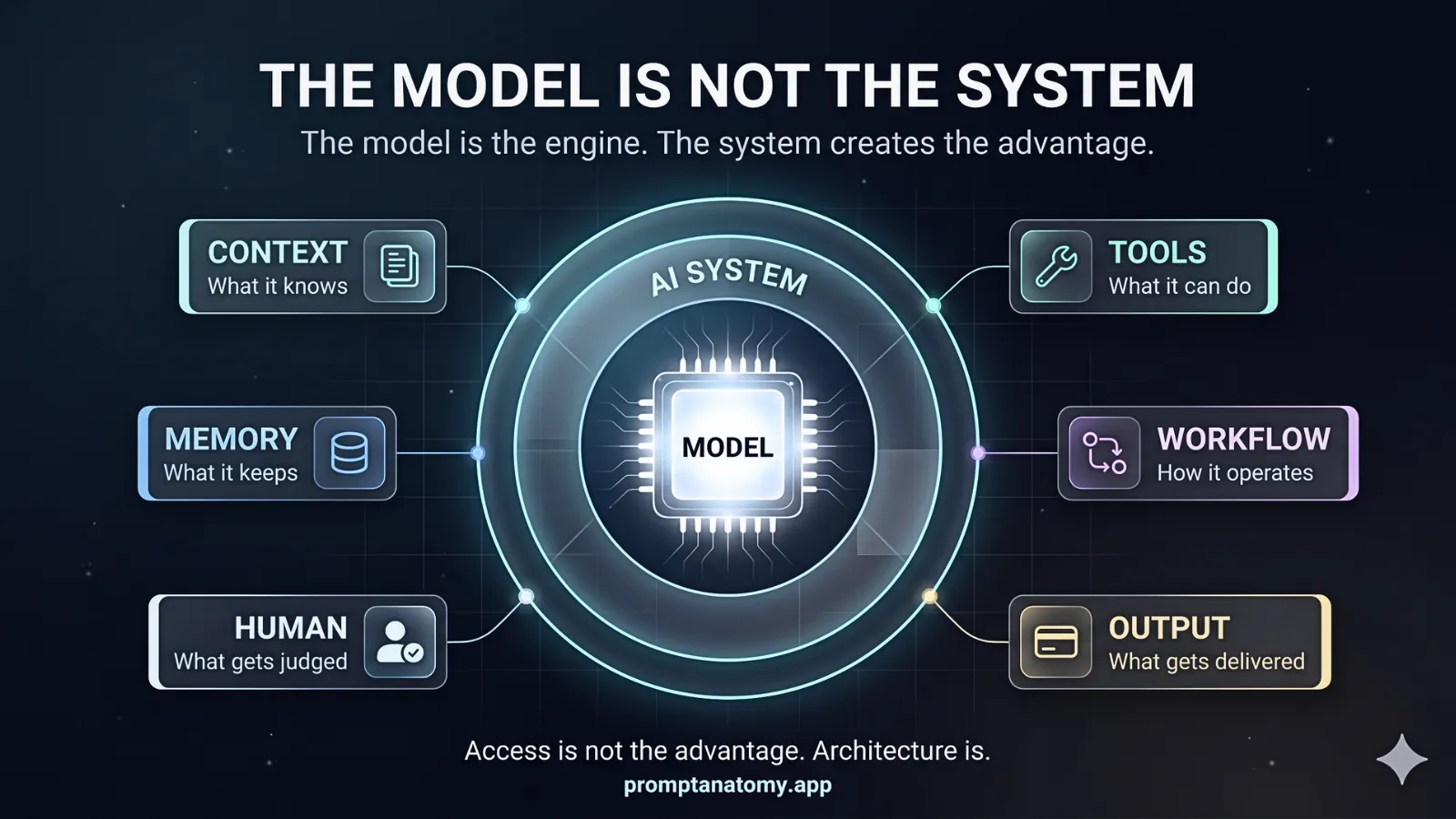
The hero diagram shows the model at the center of a larger design. In practice, durable implementations combine five layers that must work together—not five tools purchased separately.
Workflow is the sequence humans already expect: intake, draft, review, handoff, archive. AI steps belong at named points in that sequence, with clear entry criteria (what triggers automation) and exit criteria (what must be true before the next step). If the workflow is implicit, the model will invent one—and it will not match how Legal, Sales, or Support actually work.
Context architecture defines what the model may see, when, and why. That includes document scope (playbooks, tickets, policies), freshness rules, and tags such as approved versus draft. Poor context design is the main driver of confident wrong answers; What Is Context Architecture goes deeper on layering and retrieval choices.
Evaluation is how you know an output is good enough before it ships. That means held-out test cases, pass/fail checks on high-risk fields (pricing, compliance clauses, PII), and regression runs when prompts or models change. Evaluation Hooks for AI Workflows describes where to attach those checks without slowing every request.
Governance names who may change prompts, tools, data access, and production configuration—and how changes are reviewed. Without governance, “quick fixes” in one team’s chat thread become everyone’s undeclared policy.
Together, these layers turn access into an operable capability. The model remains one component inside them. The same split applies outside enterprise AI—a Telegram mini app’s Web App renders frames while a hosted API owns scores (Telegram Game Stack).
The cost of chat-only AI
A mid-size services firm rolled out copilots to sales and support in the same quarter. For six weeks, metrics looked strong: more proposals drafted, faster first responses, positive anecdotal feedback from top performers.
Then operations pain showed up in audit-shaped form. Legal found inconsistent disclaimers across regions—wording that sounded right in chat but did not match the approved clause library. Support could not reproduce strong answers from prior weeks when managers tried to train new hires; the best outcomes depended on who asked and which sidebar tools they used. IT discovered three overlapping integrations writing to the same CRM fields, with no single owner for conflict resolution.
The language model was adequate throughout. The missing system was shared context (what is allowed into the prompt), review gates (who signs off before send), and ownership (who fixes drift when models or tools change). Pilot spend continued, but leadership could not answer a basic question: What is our pass rate on the workflows that matter?
That gap is expensive in ways spreadsheets undercount: rework hours, delayed deals, compliance remediation, and loss of trust from internal teams who stop sharing what actually works. Chat-only AI maximizes visible speed and minimizes accountable design.
Worked example: proposal support
The table below is a compact design record for one workflow—RFP and proposal first drafts—not a slide checklist. Use it as a template for how layers align to a single measurable outcome.
| Layer | Design choice |
|---|---|
| Outcome | First-draft RFP responses in 48 hours, reviewed before send |
| Workflow | Intake → approved snippets → model draft → human edit → compliance sign-off |
| Context | Indexed playbooks and past wins tagged approved only |
| Evaluation | Held-out RFP set; fail on wrong pricing tier or missing clause |
| Governance | Marketing owns prompts; Legal owns policy context; IT owns integrations |
Outcome. The business cares about cycle time and error rate, not tokens generated. Forty-eight hours with review before send forces the workflow to include humans at the right step—not as an afterthought when someone panics.
Workflow. Intake captures opportunity metadata; only then does the model see approved snippets. Human edit is mandatory; compliance sign-off is a hard gate for external send. Skipping a step invalidates the audit trail.
Context. “Indexed playbooks and past wins tagged approved only” prevents the model from citing draft or informal wins that Legal never cleared. That single rule removes a common source of plausible-but-wrong proposals.
Evaluation. A held-out RFP set with explicit fail conditions (wrong tier, missing clause) turns quality into a repeatable test. When the model or prompt changes, you rerun the set before promoting to production.
Governance. Split ownership avoids the fantasy that “IT owns AI.” Marketing maintains prompt templates; Legal maintains policy context; IT maintains integrations and access logs. When something breaks, each owner knows their patch surface.
If you are designing agent-style automation next, carry the same discipline into tool boundaries and escalation—How to Design an AI Agent Workflow maps business tasks to agent-ready processes.
First 30 days
The goal of the first month is not more tools. It is one workflow documented end to end, with metrics and pass/fail criteria you can defend in a steering meeting.
-
Name one workflow with a clear metric—not “use AI more.” Example: “Reduce median time from RFP intake to compliant first draft to 48 hours, with fewer than 2% clause errors on a held-out set.” Without a metric, pilots become demos that cannot be compared week to week. Failure mode: picking the flashiest use case instead of the one with measurable pain. Owner: operations lead with line-of-business sponsor.
-
Pair an ops owner with IT for context and evaluation. Ops defines steps and sign-offs; IT implements retrieval boundaries, logging, and test harnesses. Failure mode: IT ships integrations before ops writes the workflow—integrations encode chaos. Owner: joint working session weekly until the pilot checklist is green.
-
Pause new tool purchases until that workflow is documented end to end. Tool sprawl is a symptom of missing system design. Document inputs, outputs, reviewers, and data classes first; then buy or enable tools that fit the map. Failure mode: buying another copilot to “fix” inconsistency created by the last three. Owner: CIO or transformation lead enforces the pause with executive backing.
-
Run a pilot with pass/fail criteria, not slide decks only. Define what “promote to production” means: evaluation thresholds, rollback plan, and who may change prompts in production. Report pass rate and cycle time, not adoption screenshots. Failure mode: declaring victory after a single executive demo. Owner: pilot lead publishes weekly scorecard.
Thirty days of focused system design beats a year of model shopping. Access to a strong model is table stakes; architecture is the advantage. For reading paths by role and category, see Prompt Anatomy Foundations. Shared terms: Glossary.