Multiple agents can work when each step has a narrow contract. Without that, you get expensive ping-pong—research agent asks draft agent to clarify, draft agent invents facts, checker fires late—and untraceable errors in production. The pattern is not “more agents because vendors sell orchestration.” It is specialization with explicit handoffs, shared state, and human gates on anything that commits the business.
Use this after a single-path workflow proves value with eval and audit. Early pilots should stay one retrieval + one model call until metrics justify complexity—see how to design an AI agent workflow and handoff rules between humans and AI before splitting agents. For orchestration framework selection (LangGraph, CrewAI, Microsoft Agent Framework), see production selection guide. For run-state logging at scale, see Multi-Agent Observability.
Pattern overview (orchestrator and specialists)
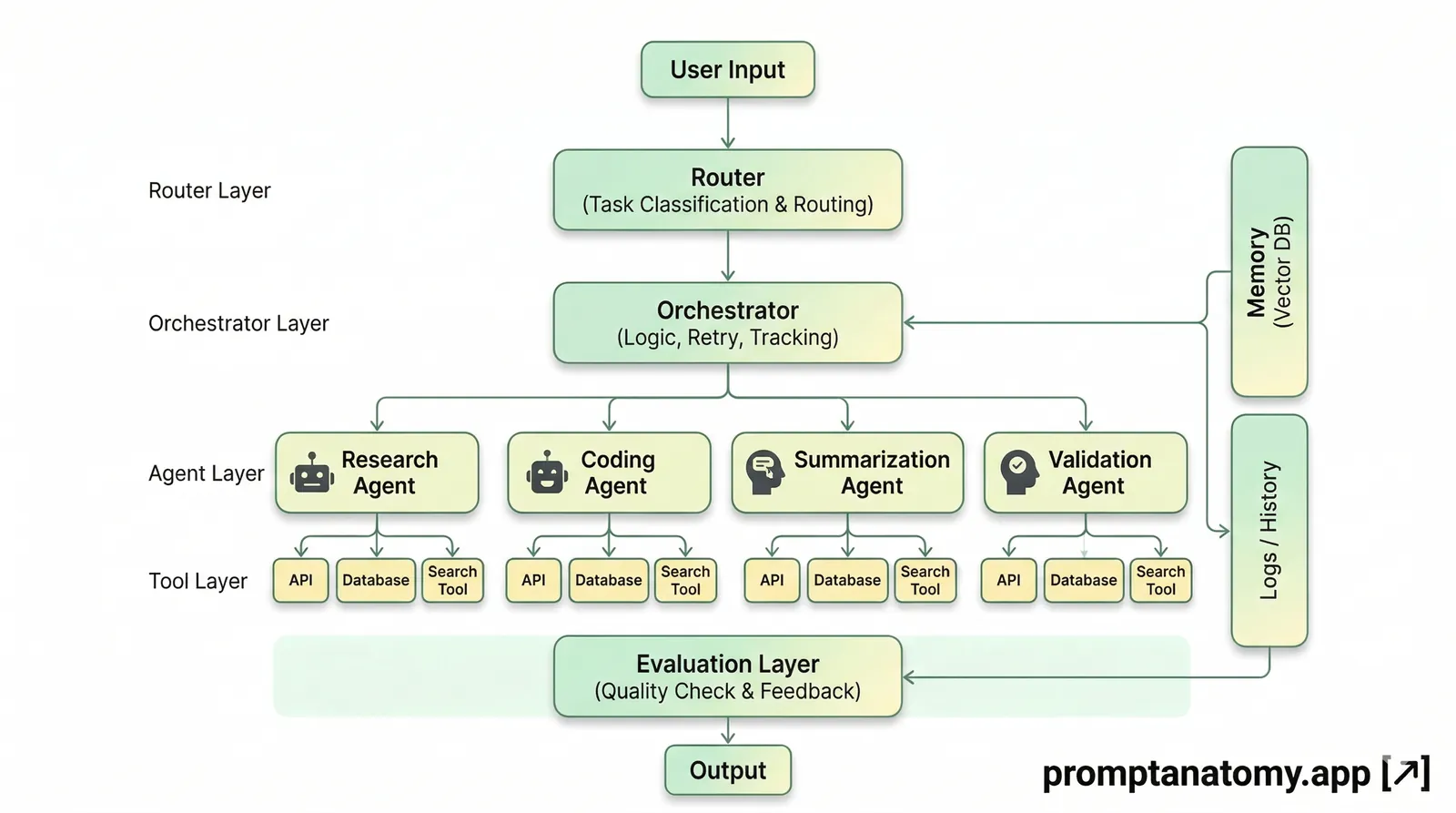
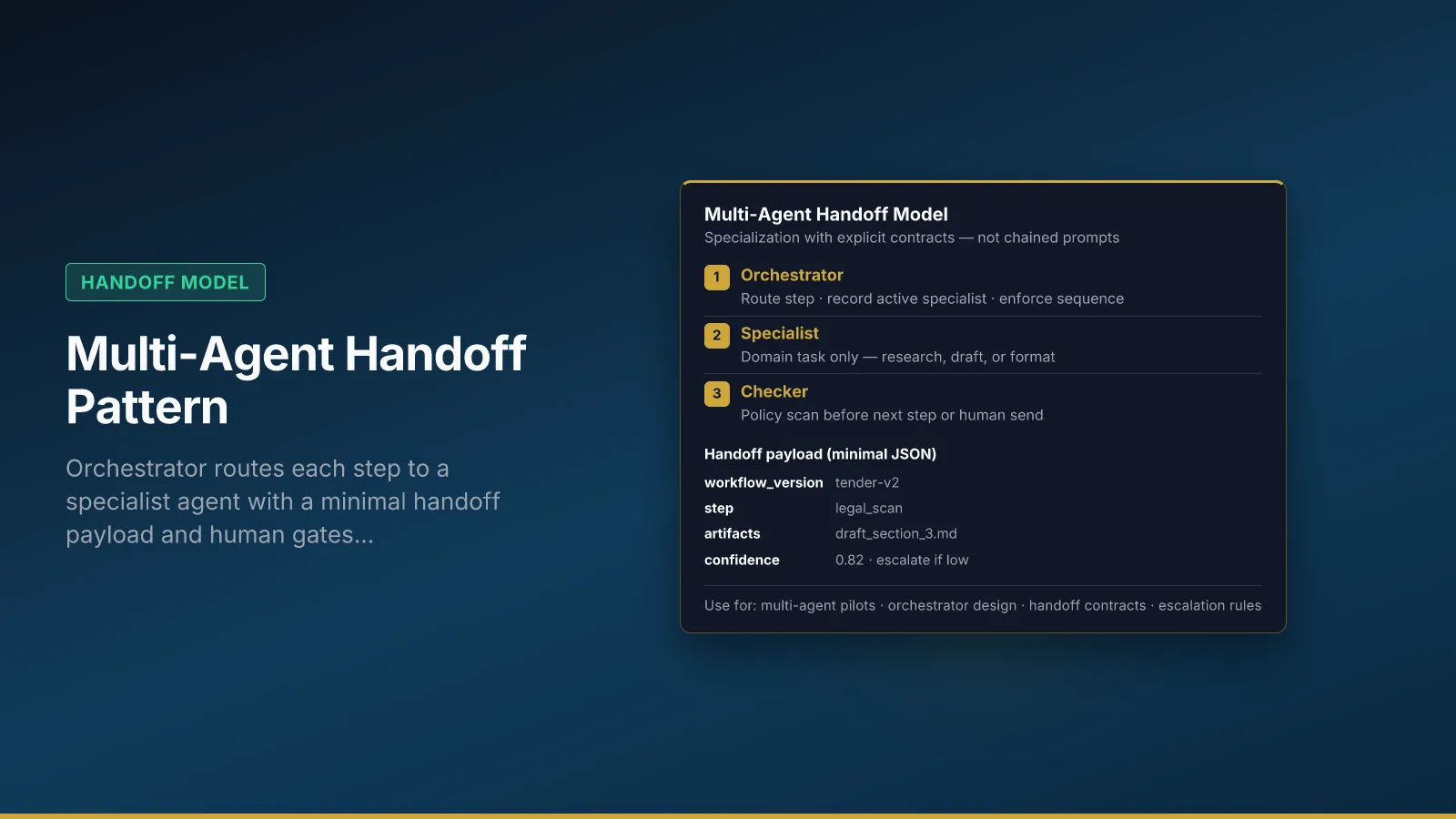
Orchestrator routes the task to a specialist step: research, draft, legal scan, formatting. It does not do everyone’s job—it enforces sequence and records which step is active. Orchestrator logic should be boring state machine code where possible, not a chatty meta-model improvising process.
Handoff payload carries goal, constraints, artifact references, open questions, and confidence. Payloads are small and structured—not full chat history dumped forward. Each specialist trusts the contract, not the entire thread.
Checker agent or rule engine validates before the next step or before human send. Policy checks often belong in rules, not LLM “please verify compliance.”
Human gate on external actions, policy hits, low confidence, and VIP flags—aligned with data boundaries triggers.
Northline’s tender pilot uses orchestrator tender-v2 with steps retrieve → draft_section → legal_scan; support-reply-v3 stayed single-path until pass rate held—do not multi-agent by default.
Handoff schema (minimal JSON)
Store schema version with workflow ID in logs. Replay drills use payloads to reconstruct order.
{
  "workflow_version": "tender-v2",
  "step": "legal_scan",
  "inputs_hash": "...",
  "artifacts": ["draft_section_3.md"],
  "open_questions": [],
  "confidence": 0.82
}
workflow_version ties to registry and eval set. artifacts are references, not embedded secrets. open_questions force human answer before proceed—empty array means “do not hallucinate closure.” confidence below threshold routes to review per handoff table in human-AI handoff rules.
Log each handoff in audit trails with step name and hash—multi-agent without logs is multi-blame.
When not to use multi-agent
Single-step generation with clear eval — one prompt ID, one retrieval scope, smoke gate in CI. Adding agents adds latency and failure modes without benefit.
Tasks where one retrieval + one model call suffices — most tier-2 assists, many internal summaries. Measure handle time and pass rate before splitting.
Early pilots — prove outcome metric and governance artifacts first. Split only when one path hits eval ceiling or qualitatively different steps need different tools/models.
“Because the platform supports agents” — not a criterion. Criterion is evidence that specialization reduces overrides or legal flags while holding pass rate.
Operating multi-agent with governance
Each specialist step needs an owner in RACI—who approves prompt changes for that step, which eval cases gate promotion. Forum reviews step additions like new connectors—see risk cadence.
Expand allow lists per step in boundary matrix; routing agent at Northline added one write row after fifty-case eval—not full CRM write because orchestrator could.
Eval sets need per-step cases and end-to-end cases—legal scan may pass while draft step drifts.
Failure modes
Chat history as handoff — token bloat, leakage across tenants, unreproducible runs.
No checker between draft and send — customer sees unchecked enthusiasm.
Orchestrator as creative writer — process drift; keep orchestration deterministic.
Missing human gate on external tools — email send, portal upload, ticket close.
Multi-agent handoff pattern works when contracts are explicit and logged—not when more models talk longer.