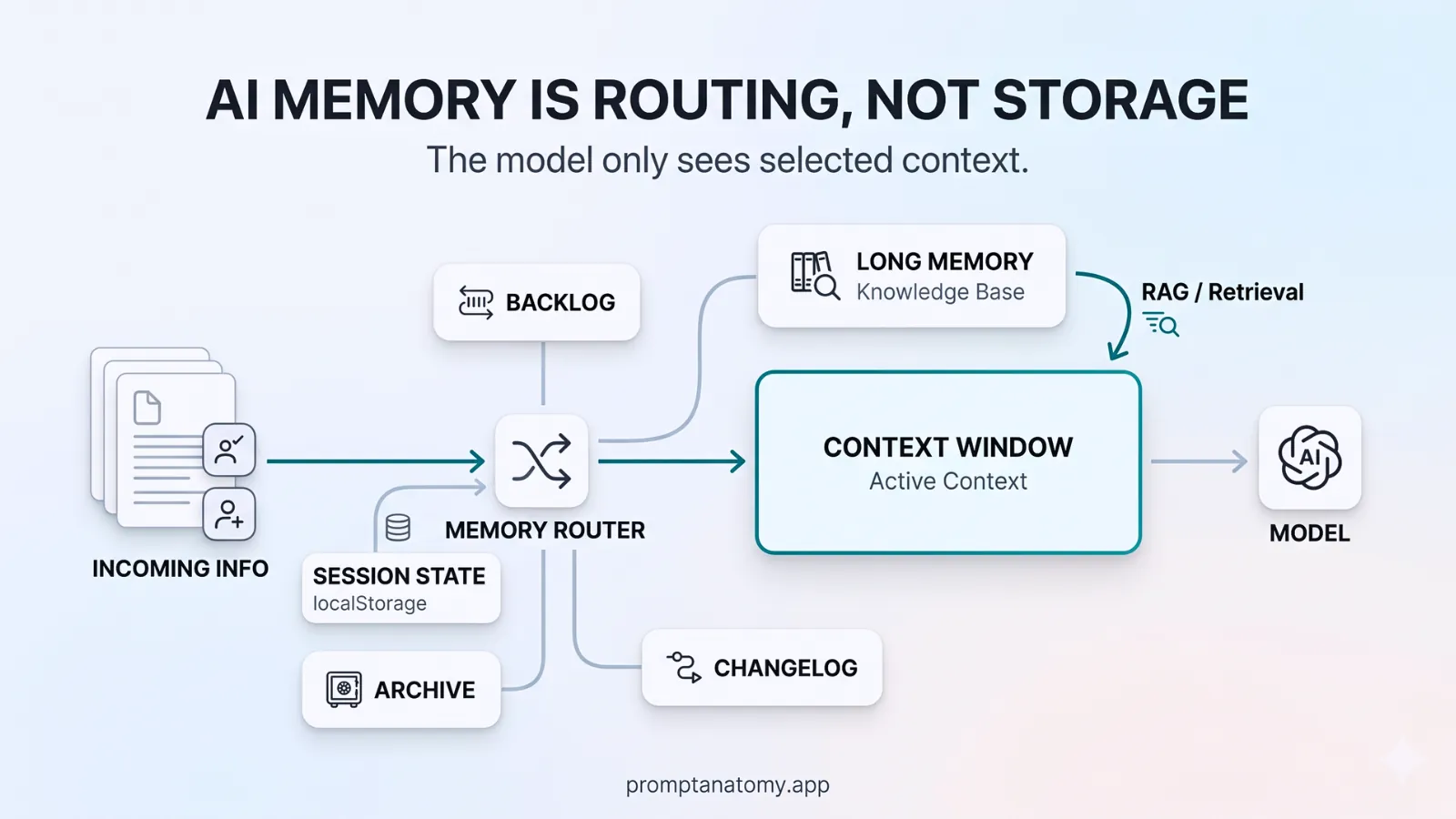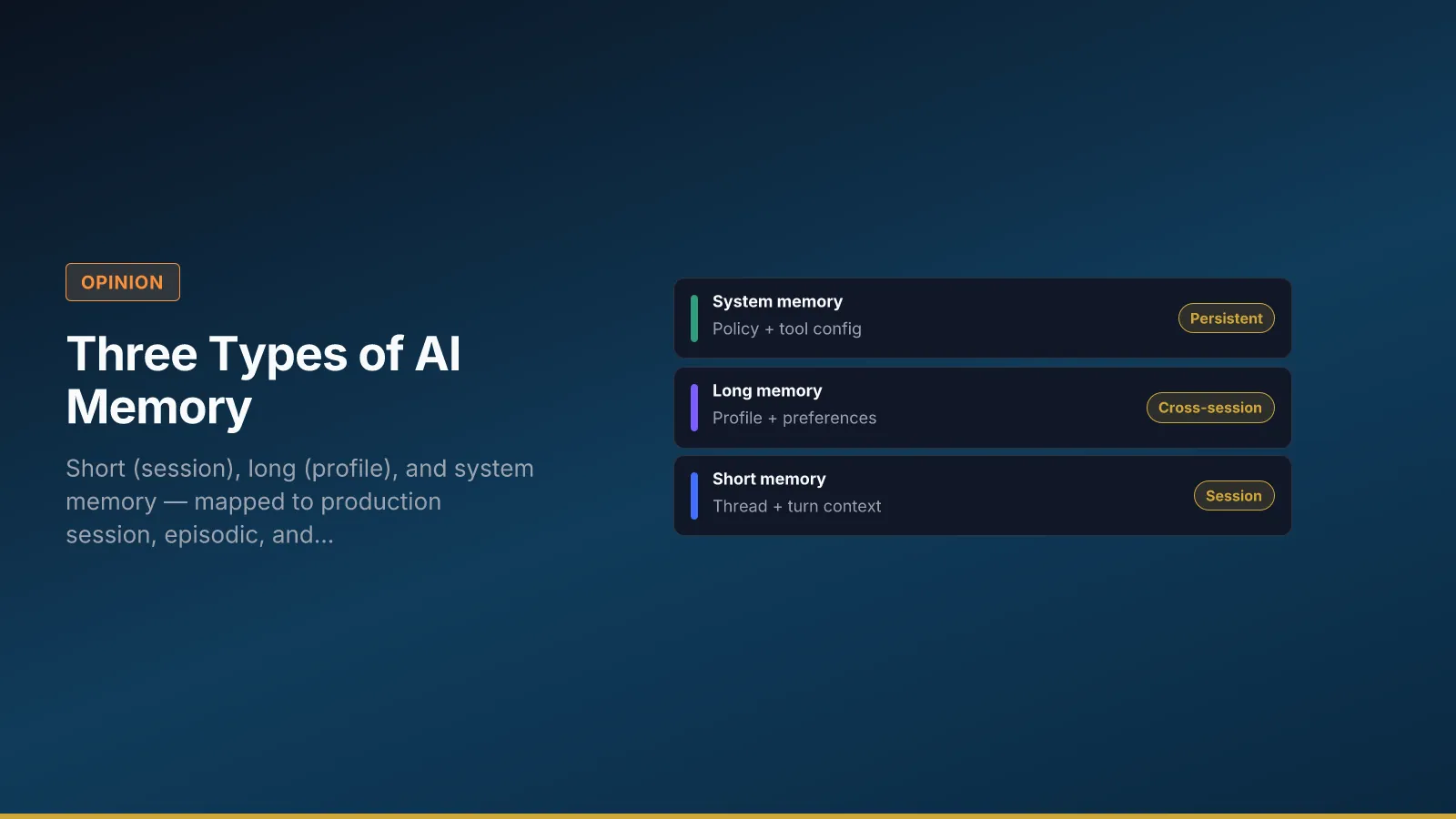
The hero card stack is simple: short (session), long (profile), system (controls behavior). “Remembers now / remembers you / controls output” is consumer language — useful only when you translate it into retention rules, TTL, and owners before production.
Primer — for operational detail see Memory Types for AI Systems.
Northline B2B scoped assistant memory to ticket thread context only, with explicit TTL and no cross-customer profile blending, before expanding to renewal workflows. The poster’s three cards became three storage decisions with different audit questions — not one “memory” toggle in a vendor console.
Short — session memory
Session memory is this thread or run: recent turns, tool results, temporary scratch context. It should expire when the case closes. It should not silently become the policy record or training corpus.
Support workflows fail when “what worked yesterday in chat” cannot be reproduced because session state lived in one agent’s sidebar. Session data belongs in logs tied to case_id and tenant_id — not in a shared doc titled “good prompts.”
Production mapping: session and working (in-prompt) memory in the playbook — assembled for one invocation, deleted or archived on case close.
Long — profile memory
Profile memory is persistent facts about a user or account — preferences, tier, locale, open tickets, escalation history. It needs consent, correction paths, and deletion when customers churn.
Profile data is where GDPR and contract questions actually live — not in generic “we use AI” statements. Silent profile injection is how Customer A’s issue appears in Customer B’s draft.
Production mapping: episodic memory — human-visible summaries, tenant-scoped, refreshable on a schedule documented in the workflow record.
System — behavioral control
System memory is instructions and configuration: prompts, tool allow lists, model routing, safety rules. It is not “more history.” It is how the product behaves across every run.
Changes here are releases — version, review, eval — not casual edits in a shared chat. Yesterday’s experiment must not become today’s default because nobody versioned the system prompt.
Production mapping: organizational configuration plus registry rows — versioned policy packs, approved corpora mounts, routing rules owned by governance.
Mapping poster terms to production design
Use this table in design reviews so poster language and playbook vocabulary stay aligned.
| Poster term | Production term | TTL example | Owner |
|---|---|---|---|
| Short (session) | Session / working | End of thread or case | Ops lead |
| Long (profile) | Episodic / profile | Account lifecycle; delete on churn | Privacy + product |
| System | Organizational config | Release-versioned; eval on change | Governance + IT |
If a vendor feature does not map to a row, treat it as unscoped persistence until an owner and TTL exist on the canvas.
Do not merge the cards
Teams that dump everything into “memory” get unauditable behavior: session experiments become defaults, profile bleed crosses tenants, system prompts drift without changelog entries.
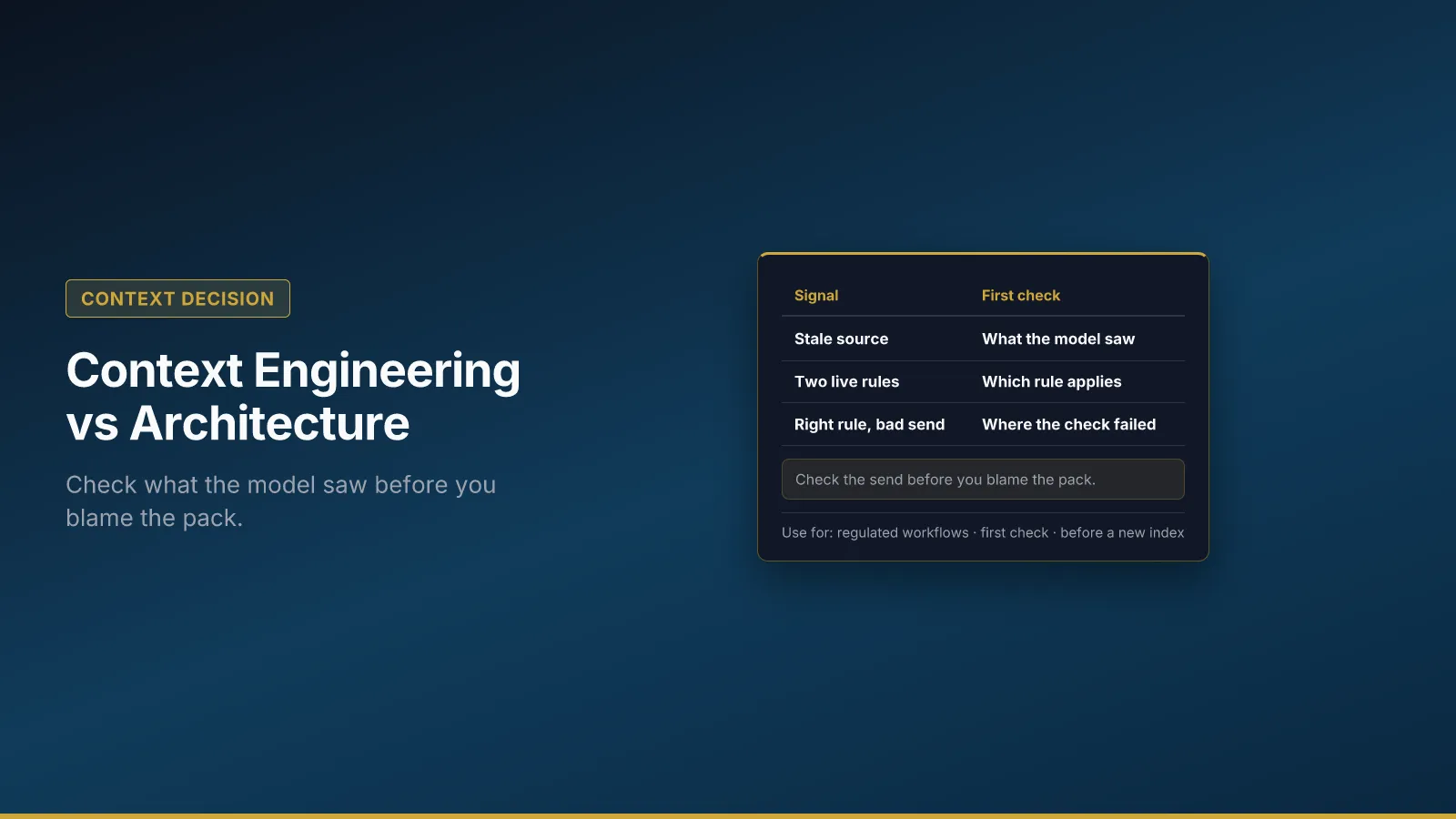
Separate storage, TTL, and access controls per card — then wire retrieval and boundaries in Data Boundaries for AI Agents. A remembered preference may color the draft; only a checked result of this send may be written as done, which is memory is not state. Who may change system-level configuration belongs in AI Governance Roles and Ownership.
When agents promote from assist to tool use, memory scope should shrink before it expands — Northline refused profile blending until ticket-only session memory held pass rate for thirty days on held-out cases.