AI risk does not wait for annual audits. Models, prompts, and connectors change monthly; customer contracts still require explainability and retention. A light, recurring forum keeps workflows aligned with policy as the stack evolves. Skipping cadence turns governance into cleanup after incidents—and cleanup without minutes is storytelling, not operations.
Northline B2B runs a monthly forum for live workflows including support-reply-v3. This article defines cadence, standing agenda, who attends, what outputs must exist, and includes sample minutes you can paste into a wiki. Pair with governance roles, audit trails, and data boundaries so meetings change process, not only slide decks. For skills that actually scale beyond chat basics, see What Scales AI Beyond the Basics.
Choosing cadence and duration
Frequency should match how often you change production AI configuration—not how often leadership wants a dashboard.
| Team size | Frequency | Duration |
|---|---|---|
| Pilot stage | Biweekly | 45 min |
| Multiple live workflows | Monthly | 60 min |
| Regulated industry | Monthly + quarterly deep dive | 90 min |
Northline (120 people, one live workflow, regulated customer data) runs monthly 60 minutes, plus biweekly 30-minute eval check-ins during model vendor trials. Pilot-stage teams need biweekly rhythm because prompts and context packs change faster than habits form; mature programs can monthly forum with weekly automated eval reports to owners.
Cap vendor demos at five minutes. The forum is for decisions—promote, pause, retire, or require new cases—not for model beauty contests.
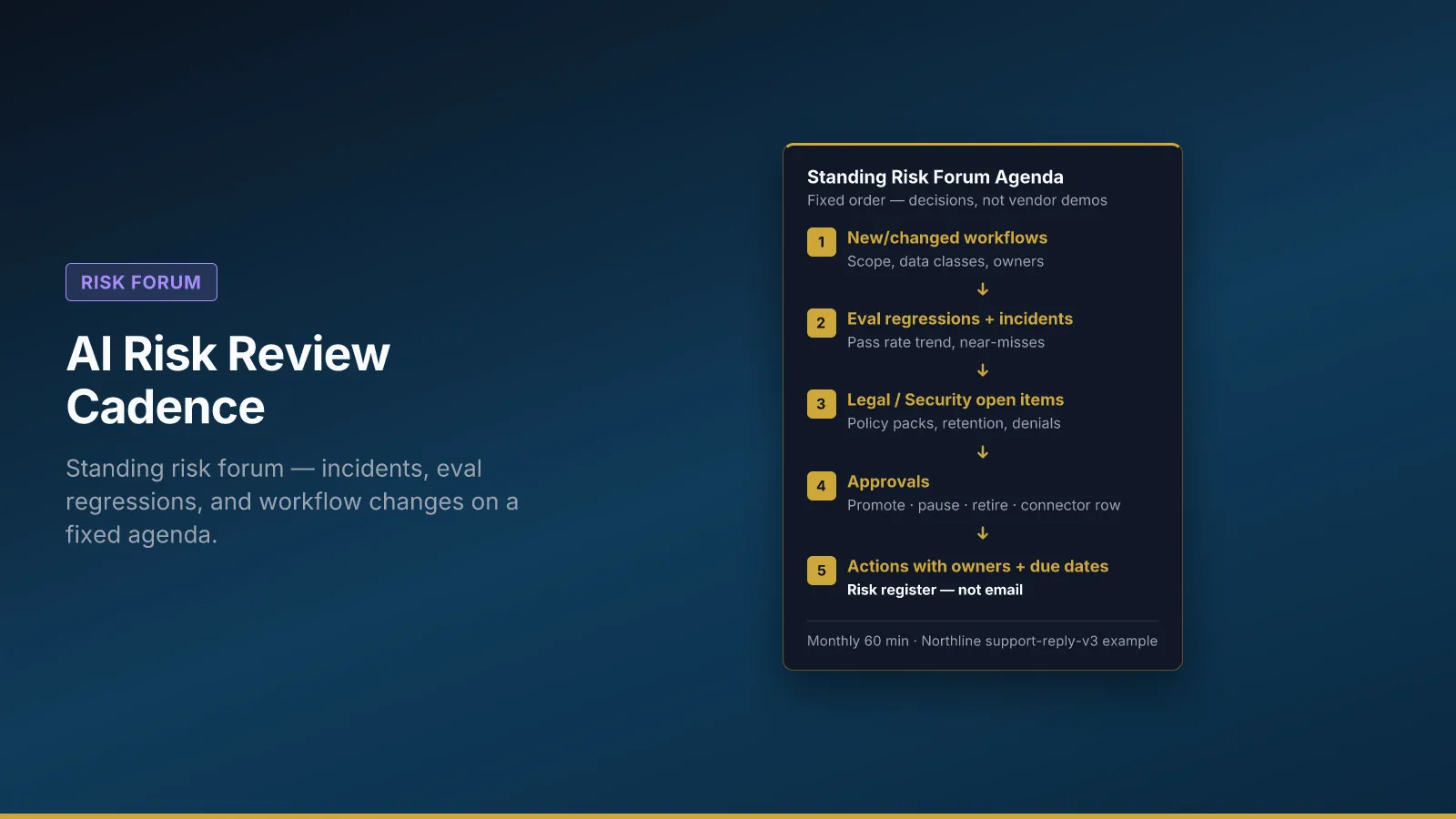
Standing agenda (every session)
Read the agenda in order so nothing chronic stays invisible. Process owners prepare sections 1–2; IT prepares log schema gaps; Legal prepares open policy items.
- New or changed workflows since last meeting—scope, data classes, owners, boundary matrix updates.
- Eval regressions and incidents—pass rate trend, near-misses, overrides worth pattern review.
- Open items from Legal / Security—policy pack bumps, retention questions, denial-path tests.
- Approvals—promote shadow traffic, pause workflow, retire prompt version, approve new connector row.
- Actions with named owners and due dates—stored in risk register, not email.
Northline requires one metric and one decision minimum per session. If neither exists, cancel and fix preparation—not attendance.
Sample meeting minutes (Northline — 2026-05-15)
Use this format so audit and operations see the same facts six months later.
Attendees: VP CS (sponsor), Support ops (owner), IT lead, Legal counsel (30 min), Ops analyst
1. Changes since April: Policy pack bumped to support-policy-2026-04; no new tools. Context spec updated with policy_pack_version in log schema per prior action.
2. Eval / incidents: Pass rate 93.1% (target ≥92%). One near-miss: draft cited deprecated refund rule—caught by checker; no customer send. Root cause: KB article not re-tagged after legal edit. New eval case eval-04 added; owner Support ops, due May 19 for KB retag.
3. Legal open items: None.
4. Decisions: Promote shadow traffic from 50% to 80% of tier-2 queue after four-week pass hold; IT to add log field policy_pack_version by May 22 (completed in staging).
5. Actions: Support ops — retag KB articles (due May 19). IT — verify log field in prod (due May 22). Ops — post override summary next session.
Minutes stored in risk register with link to audit sample for ticket #4821. Decisions reference registry version 1.4.2 and eval set support-reply-eval-25.
Attendees and participation rules
Executive sponsor attends monthly or delegates with written authority—useful when promotion affects customer commitments or tool spend.
Process owners for each live workflow attend always; they own sections 1–2 and action lines.
IT attends for integrations, logging, CI smoke failures, and boundary enforcement evidence.
Legal / compliance attends when policy packs, retention, or customer-facing language changes—or within 24 hours async review when only eval cases changed.
Ops or quality lead brings metrics: pass rate, override rate, mean time to process update after incidents.
Optional guests (vendors, new team leads) do not dilute decisions—timebox Q&A to end.
Outputs that count as governance
Slides alone are not outputs. The forum should produce durable artifacts:
Updated risk register — workflow × risk × mitigation × owner. Link each row to workflow ID and current registry version.
Decision log — promote/pause/retire with date, approver, eval evidence. Link to structured prompt system changelog lines.
Context and boundary changes — policy pack version, matrix row, or retrieval tag—not “we will discuss.”
Eval case additions from near-misses within one week—see evaluation hooks.
Northline tracks mean time to process update after incidents. Slow fixes mean governance theater.
Operating the forum without fatigue
Schedule the next 60-minute slot before adjourning—empty calendars become skipped months. Use the same wiki template every time so reviewers build habit.
When eval sample size is below agreed threshold, pause promotion votes—decisions without data recreate vibe prompting at scale.
During model trials, biweekly eval check-ins prevent monthly surprises—forum focuses on decisions, not reading spreadsheets live.
Connect forum actions to RACI: every action line has one R and one due date; A approves closure next session.
Monday start: Copy the sample minutes template. Book six sessions forward. Assign one process owner to prepare section 2 next time. Link last session’s actions to audit replay drill outcomes.
Risk cadence is how governance stays a verb—incidents, near-misses, and workflow changes on the agenda, every time.