AI governance is not a policy PDF in a drawer. It is clear ownership for how workflows change, what data they touch, and who answers when something goes wrong. Without RACI-style clarity, “everyone owns AI” becomes “no one owns incidents”—and the first serious near-miss becomes a circular email thread instead of a process update with a due date.
This guide uses Northline B2B, a 120-person services firm, and their live workflow support-reply-v3 (tier-2 assist). The same pattern applies to other workflows: adjust names and systems, not the structure of accountable vs responsible vs consulted vs informed. Pair this article with AI risk review cadence, audit trails, and data boundaries so ownership connects to forums, logs, and enforcement—not slides alone. For a visual primer on the control ladder (tokens through RAG), see Five Levels of AI Control. When stakeholders confuse prompt tricks with operating discipline, Prompt Engineering Memes vs Reality names the gap governance must close.
Why RACI matters for AI workflows
Traditional software RACI maps features to teams. AI workflows add mutable language (prompts), mutable context (policy packs, retrieval), and probabilistic outputs that still create customer commitments. If only IT is named, business wording drifts in chat threads. If only Legal is named, integrations never get boundary enforcement. If only a vendor is named, you cannot reconstruct ticket #4821 six months later.
RACI forces explicit answers: Who can approve customer-facing go-live? Who owns eval pass rate? Who implements deny rules in connectors? Who is accountable when a deprecated refund rule appears in a draft? Northline answered these on one wiki page linked from their risk register—before they increased shadow traffic from fifty to eighty percent.
RACI for support-reply-v3 (Northline)
The table below is their production RACI. Copy the shape, not the names, into your first governed workflow.
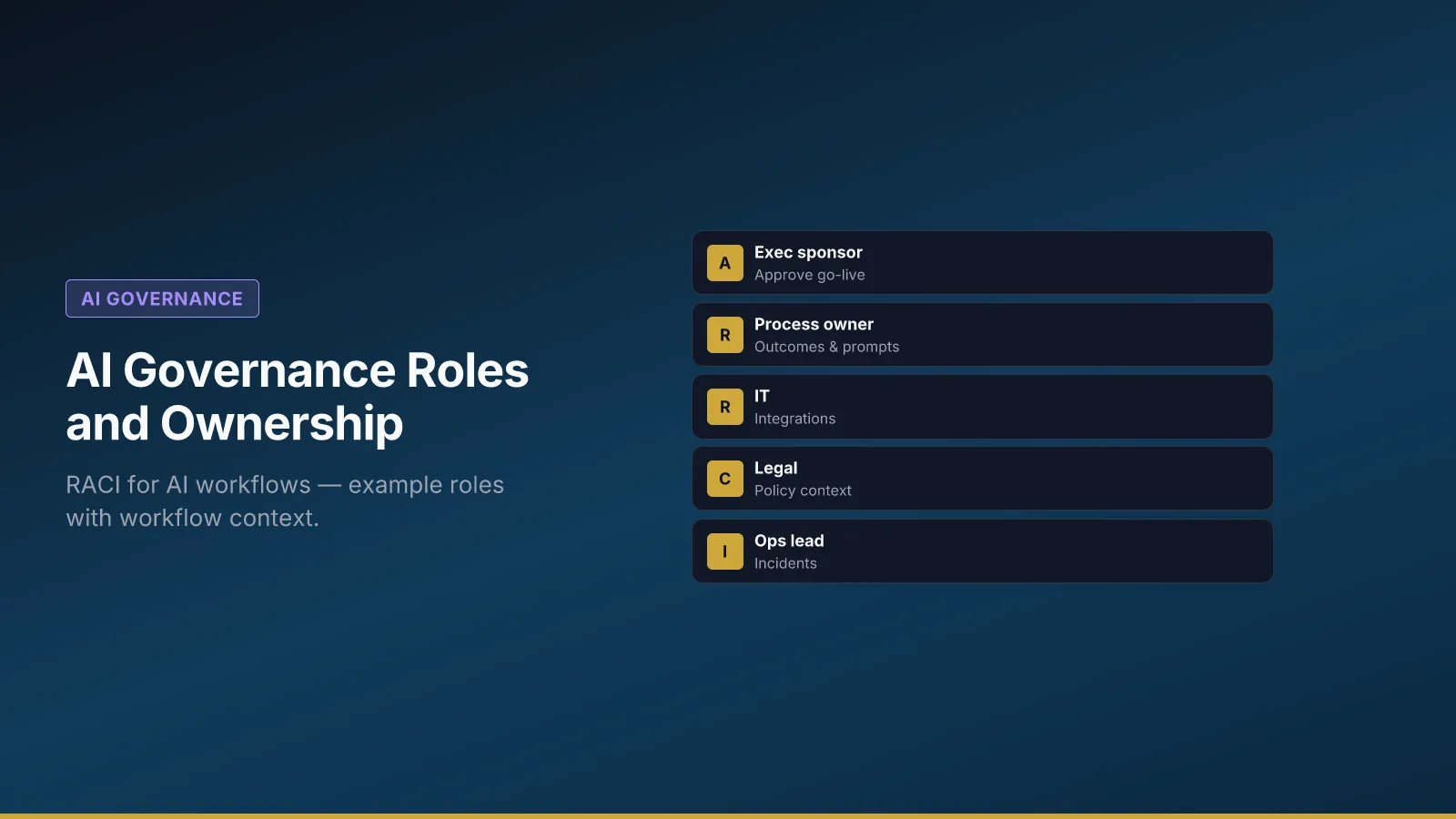
| Activity | Exec sponsor (VP CS) | Process owner (Support ops) | IT | Legal | Ops lead |
|---|---|---|---|---|---|
| Approve customer-facing workflow | A | R | C | C | C |
| Maintain context / policy packs | I | C | R | A | C |
| Integrations and secrets | I | C | A/R | C | I |
| Eval set and release gate | I | A | R | C | C |
| Incident review | I | C | R | A | R |
R = responsible, A = accountable, C = consulted, I = informed
Northline’s VP Customer Success is accountable for go-live but does not edit prompts daily. Support ops owns eval pass rate and override review—they block promotion when smoke fails. Legal is accountable for policy pack support-policy-2026-04; IT implements retrieval boundaries so HR data never mounts on this workflow ID. Ops lead tracks override reasons and feeds the monthly risk forum.
When eval case #17 failed on VIP language, the process owner opened the ticket; IT updated boundary triggers; Legal confirmed approved phrasing; sponsor was informed, not surprised in a quarterly review.
Minimum viable governance
You do not need a twenty-page policy to start. You need five roles filled with humans who accept escalation.
Executive sponsor sets operating priorities—which workflows matter, whether to pause tool sprawl, whether promotion requires forum vote. They are not the daily prompt editor. Northline’s sponsor blocked a second copilot until pass rate held—governance as business decision.
Process owner per workflow can say no to scope creep and owns eval outcomes. If overrides cluster on the same clause, the owner adds cases or fixes context—they do not “train reviewers harder” indefinitely.
IT owns integrations, logging, secrets, and connector deny paths. Prompt text that says “do not access HR” is not enforcement; IT configuration is.
Legal owns policy context and prohibited uses—not casual prompt tweaks in prod. Policy pack version appears in audit trails so replay is possible.
Ops or quality lead tracks metrics, override sampling, and forum agendas. They connect RACI to evaluation hooks results leadership can read.
Anti-patterns that look like governance
“Everyone owns AI” means incidents have no R line. Fix: one process owner per workflow ID on the canvas.
IT writes all prompts without process owners produces technically integrated but misaligned outcomes—drafts optimize for model behavior, not CSAT or policy.
Legal only after a breach makes governance cleanup, not design. Involve Legal when policy packs are created, not when a regulator asks for logs you do not have.
RACI in a deck, not in the wiki drifts within a quarter. Publish RACI next to the workflow canvas and link from the risk register. Copy-paste rows: Governance RACI Worksheet.
Deputy owners missing means vacation stops releases or encourages shadow edits. Name backups for high-risk workflows.
Operating RACI in practice
Publish RACI where engineers and operators already work—not only in compliance folders. Revisit when a workflow moves from pilot to production, when you add a connector, or when you split prompt IDs in the structured prompt system. Annual-only review is too slow for model vendor trials.
Link RACI lines to forum actions: “Support ops, A on eval, will post weekly pass rate.” Require one decision and one metric per risk session so ownership stays exercised.
When Northline added a routing agent pilot, they cloned RACI with a narrower write scope—expand responsibility only after eval evidence, per data boundaries.
Monday start: Pick one live or pilot workflow. Fill RACI with real names. Confirm Legal and IT know their A vs R lines. Link the page from the next risk register entry. Run one replay drill from audit logs to prove IT and process owner can reconstruct a case together.
Governance works when names are on the workflow—not when “AI” is in someone’s title and everyone assumes someone else will respond.