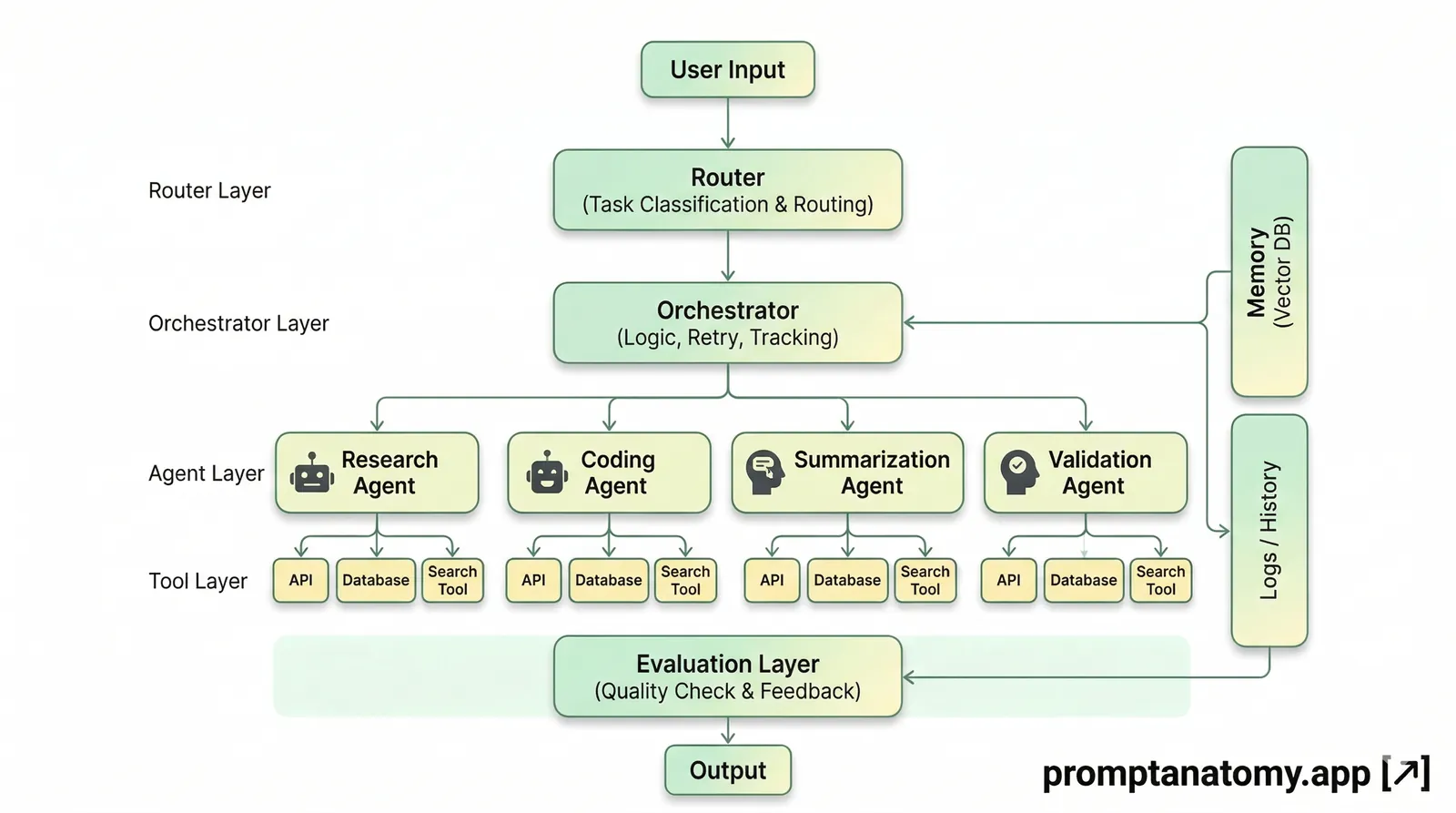
Most framework comparisons stop at developer experience. Production selection needs a different lens: reliability under real workflows, governance controls, and operational burden over months, not hackathon speed over days.
This guide compares LangGraph, CrewAI, and Microsoft Agent Framework using criteria that matter after pilot: state management, handoff control, security posture, observability, and enterprise integration path.
If you are designing collaborative agents, read Multi-Agent Handoff Pattern first. If your workflow boundaries are still unclear, start with How to Design an AI Agent Workflow before choosing any framework. Orchestration terms: Glossary.
Quick recommendation logic
Framework selection meetings often collapse into feature checklists and demo videos. A faster filter is to name your hardest workflow constraint first—stateful retries, regulated handoffs, Microsoft identity integration—and only then map candidates. The three platforms below are not ranked; they are directional defaults when a specific constraint dominates. If your team cannot articulate that constraint on one page, pause the bake-off and finish agent workflow design before buying platform complexity you cannot operate.
- Choose LangGraph when you need explicit graph/state control and custom orchestration.
- Choose CrewAI when you need fast role-based multi-agent prototyping and lighter platform overhead.
- Choose Microsoft Agent Framework when enterprise identity, policy integration, and Microsoft ecosystem alignment are primary constraints.
None is universally “best.” The right choice depends on your risk profile and integration stack.
Production comparison table
| Criterion | LangGraph | CrewAI | Microsoft Agent Framework |
|---|---|---|---|
| Orchestration model | Explicit graph/state transitions | Role/task coordination abstraction | Managed agent patterns + enterprise connectors |
| Control over handoffs | High, deterministic when designed well | Moderate, higher-level delegation model | Moderate to high, depends on configured policies |
| Observability maturity | Strong with custom instrumentation | Improving, varies by deployment pattern | Strong in Microsoft-native telemetry workflows |
| Enterprise identity/policy | Custom implementation required | Custom implementation required | Native advantage in Microsoft environments |
| Time-to-first-demo | Medium | Fast | Medium |
| Production hardening effort | Medium to high | Medium | Medium (lower if already Microsoft-first) |
| Best fit | Complex governed workflows | Rapid team-agent experimentation | Regulated enterprise operations in Microsoft stack |
Treat this as a directional matrix. Validate with one bounded pilot that includes failover and rollback, not just happy-path demos.
Deep trade-offs
Surface comparisons hide the operating cost of each abstraction layer. LangGraph exposes orchestration logic explicitly—more code to maintain, but clearer incident replay. CrewAI compresses role coordination into higher-level patterns—faster pilots, but handoff semantics can blur under audit scrutiny. Microsoft Agent Framework trades portability for ecosystem fit where Entra ID, Purview, and existing compliance workflows already anchor enterprise decisions. Read these trade-offs against your team’s skill profile and governance maturity, not against last week’s hackathon winner.
LangGraph
Strength: precise control of stateful flows and deterministic branching. Good for teams that need transparent orchestration logic and custom guardrails.
Trade-off: you own more architecture. Success depends on engineering maturity in state handling, versioning, and evaluation pipelines.
CrewAI
Strength: fast composition of role-based agents and collaborative task patterns. Useful for proving whether multi-agent decomposition adds value.
Trade-off: abstractions can hide control details that matter in regulated workflows. You may need additional structure for strict audit requirements.
Microsoft Agent Framework
Strength: operational fit where identity, access, and compliance already center on Microsoft controls. Often easier to align with existing enterprise governance processes.
Trade-off: framework choice can become platform strategy lock-in. Validate portability and non-Microsoft integration requirements before broad adoption.
Northline composite selection case
Northline B2B tested two candidate platforms for a support + renewal workflow with strict audit requirements. The workflow crossed three agent roles—classifier, retriever, and draft composer—with a human send gate on every customer-facing reply. Governance reviewers cared less about time-to-demo than about whether they could replay a failed run, identify which handoff dropped audit fields, and roll back a prompt change without freezing the whole pipeline. Crew-style collaboration delivered faster early outputs, but review flagged unclear ownership at some handoff points. A graph-oriented approach won because each transition, approval gate, and rollback path was explicit and testable.
The lesson was not “one framework is superior.” It was that operational requirements should decide architecture depth.
Selection checklist for decision meetings
Bring this checklist to the joint session with engineering, process owners, and governance—score each platform on the same workflow, with the same eval cases, and the same incident replay drill. Weight criteria by your risk profile: customer-facing flows should overweight handoff traceability and data-boundary enforcement; internal assist flows may accept lighter orchestration if audit requirements are lower. Northline used a one-page scorecard and refused to decide until both candidates completed a two-week bake-off with identical failure injection cases.
Score each platform 1-5 on:
- State and retry control for your hardest workflow.
- Ability to enforce data boundaries and permission scope.
- Support for handoff traceability and approval gates.
- Observability and incident replay speed.
- Team skill fit and maintenance burden.
- Integration fit with existing identity/compliance systems.
If two options tie, prefer the one that makes failure diagnosis faster.
Anti-patterns to avoid
Framework selection anti-patterns usually trace back to misaligned incentives: engineering optimizes for build speed, vendors optimize for demo polish, and governance enters too late to reshape architecture. Each pattern below creates expensive rework within two quarters—unclear handoffs, missing rollback paths, and observability gaps that only surface under pilot traffic. Name these explicitly in your selection memo so “fastest to hello world” does not silently become the decision criterion.
Choosing on demo polish. Fast demos often underrepresent governance complexity.
Ignoring handoff semantics. Multi-agent systems fail in transitions more than in individual prompts.
Skipping migration path planning. Framework switching later is expensive without interface boundaries now.
Conflating vendor ecosystem fit with workflow fit. Platform alignment helps, but workflow control and risk posture still decide outcomes.
When a single agent is enough
Not every business task needs a multi-agent graph on day one. If your workflow is one retrieval step, one draft, one human send gate, a single orchestrated pipeline with explicit state may outperform a role-based multi-agent demo. Promote to LangGraph or CrewAI when you have evidence that decomposition improves pass rate or diagnosability—not when a vendor labels the chatbot an “agent.”
Northline kept support-reply-v3 on a linear pipeline for twelve weeks before adding a routing agent. The routing agent earned its place only after handoff payloads, audit fields, and eval cases existed—see Multi-Agent Handoff Pattern.
Bake-off scorecard example
Score each platform 1–5 on the same workflow (support-reply-v3 routing pilot). Weights reflect audit-heavy customer-facing constraints.
| Criterion | Weight | LangGraph | CrewAI | MS Agent Framework |
|---|---|---|---|---|
| State/retry control | 25% | 5 | 3 | 4 |
| Handoff traceability | 20% | 5 | 3 | 4 |
| Data boundary enforcement | 20% | 4 | 3 | 4 |
| Incident replay speed | 15% | 4 | 3 | 5 |
| Team maintainability | 10% | 3 | 4 | 4 |
| Entra/Purview fit | 10% | 2 | 2 | 5 |
| Weighted total | 4.2 | 3.1 | 4.3 |
Microsoft Agent Framework won on identity integration for this composite; LangGraph won on explicit graph replay when Legal required step-by-step evidence. CrewAI remained useful for internal brainstorming agents with no customer send.
Microsoft Agent Framework portability
Enterprise fit is real—but portability is not. Agent Framework assumes Microsoft identity, telemetry, and connector patterns. Validate exit criteria before broad adoption: can you export orchestration logic, replay logs, and eval cases if policy requires a second cloud? Pair selection with Securing MCP and Agent Tools when MCP servers sit in the graph.
What to do Monday
- Pick one high-value workflow and map state transitions explicitly.
- Run a two-week bake-off with identical eval cases and risk gates.
- Measure override rate, incident diagnosability, and rollback speed.
- Decide with governance + engineering jointly, not engineering alone.
Framework selection is an operating model decision. Choose the platform that best supports your workflow control surface, not the one that makes the cleanest first impression. For observability after you ship, see Multi-Agent Observability. When MCP servers sit in the graph, start with Model Context Protocol for Enterprise Teams.