Teams that open with a template library scale fuzzy review habits faster than they scale quality—paste-ready prompts without a send gate ship invented facts. In late April 2026, Prompt Anatomy shipped the Enter spoke at promptanatomy.cloud (EN at /, LT at /lt/)—a free, no-account interactive lesson with a five-part prompt framework, copy-ready library, and short quiz, never calling an AI API. Source lives in the open sister repo DITreneris/lead.
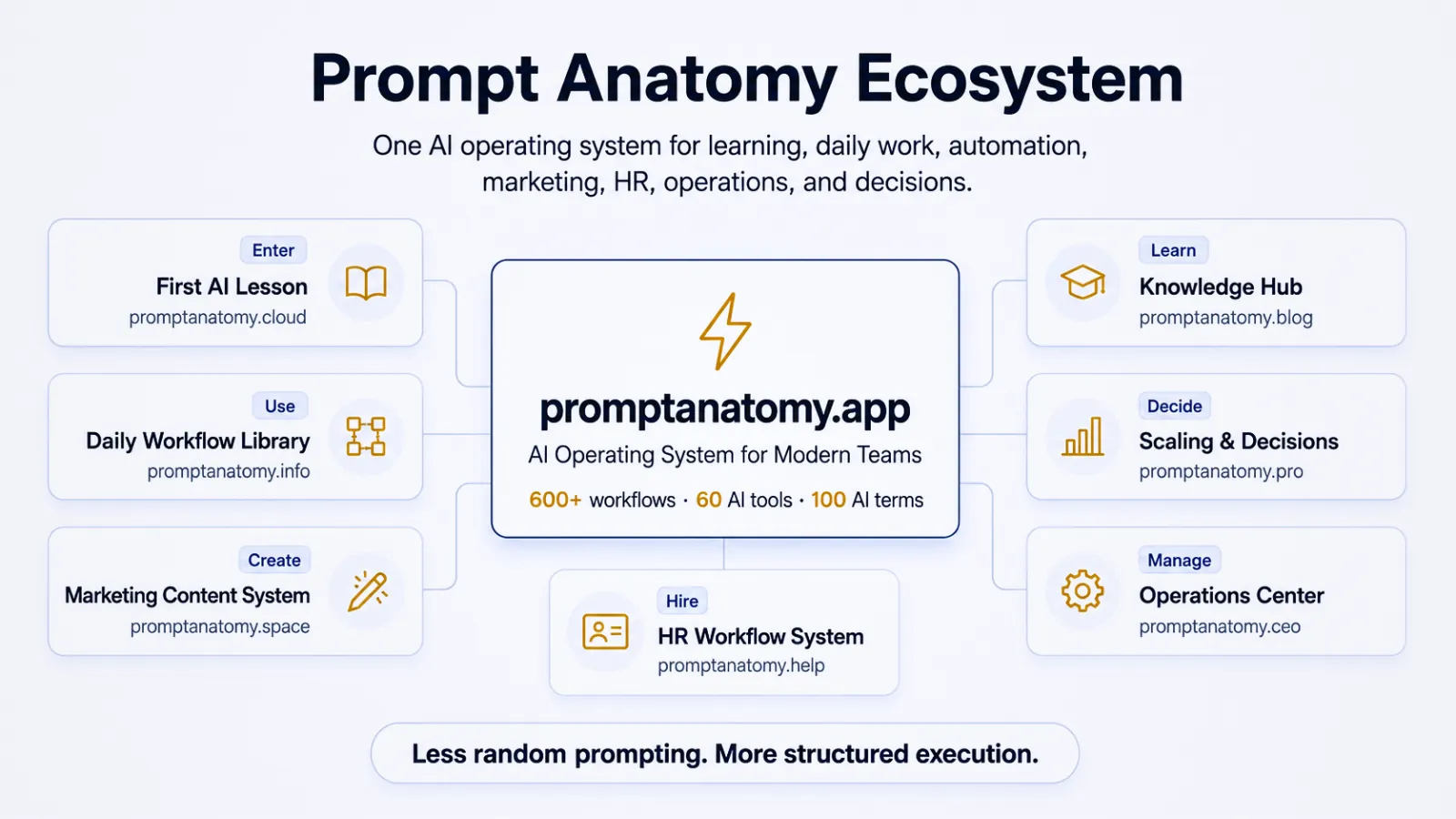
This field note covers what shipped, why slide order teaches governance before template depth, and where .cloud sits beside governed implementation content on .blog. If you are mapping properties for the first time, start with The Prompt Anatomy Ecosystem Map.
What promptanatomy.cloud is
promptanatomy.cloud is the Enter spoke—not the knowledge hub, not training checkout, and not a vertical wedge like .online or .ceo.
It is:
- A free, no-account, 15-slide interactive lesson for teams and leaders
- A five-part framework—Role, Context, Reasoning, Output, Quality control—plus a 2-minute before/after practice
- A roadmap that lists six workflows in order, with Quick send check first
- Five depth templates (meeting plan, three-level message, content feedback, team learning, email draft)
- A dual prompt library—Individual contributor and Leader tabs—with copy actions
- EN and LT PDF summaries and a program CTA to promptanatomy.app
It is not:
- An AI runtime—the lesson never calls an AI API
- An LMS, progress-tracking platform, or enterprise workflow registry
- Proof of corporate AI maturity for procurement decks
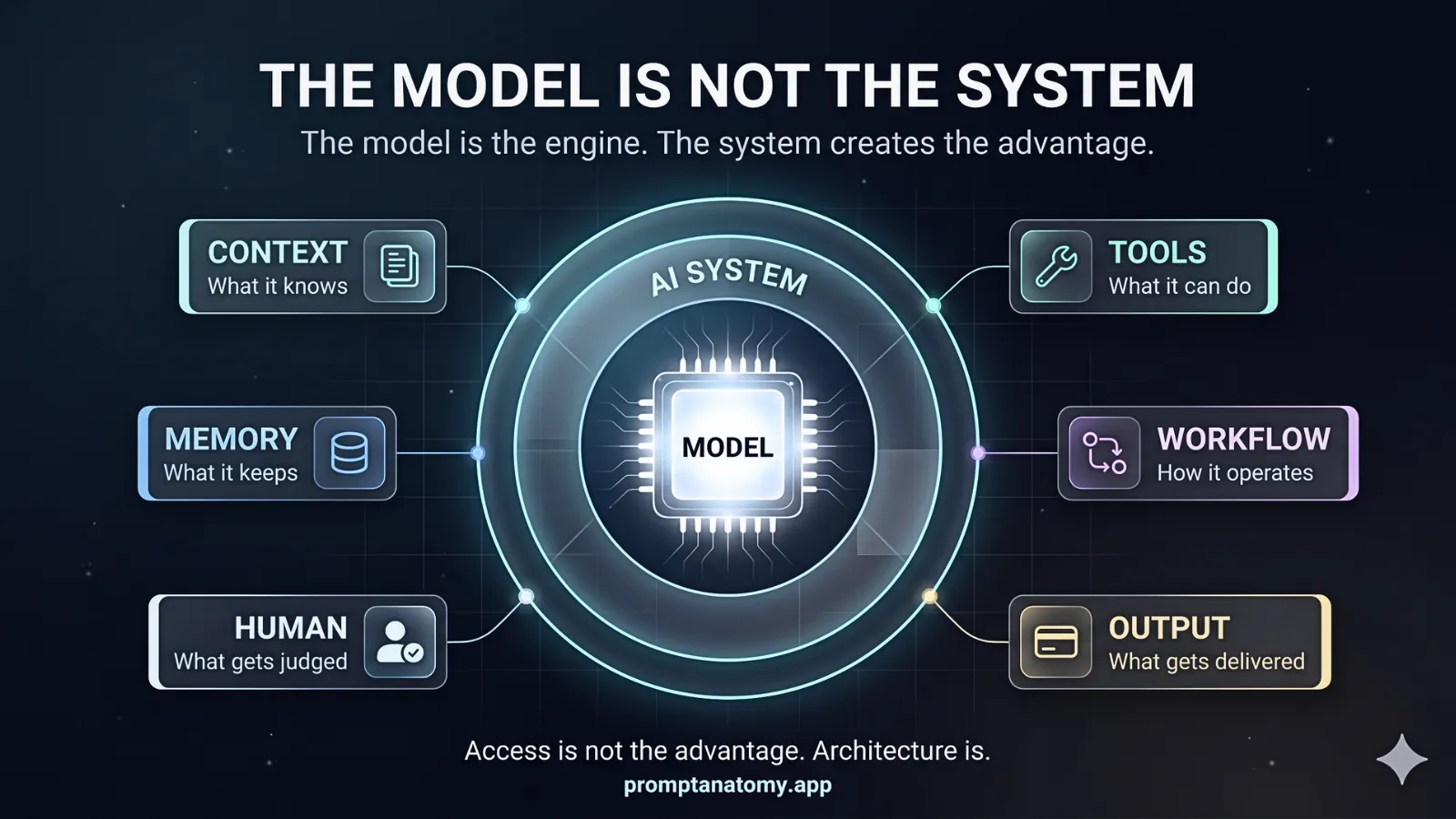
That separation mirrors a rule we repeat on .blog: the lesson is not the execution environment. See The Model Is Not the System. Visitors copy prompts into ChatGPT, Claude, or Gemini; ops teams paste registry artifacts into governed agent stacks—the architecture lesson is the same.
The journey order is the lesson
Most onboarding products rush visitors to a template library. .cloud deliberately does the opposite: after basics, framework, and a fuzzy→structured practice, the roadmap names six workflows—and puts Quick send check at the front of the queue, before meeting plans, email drafts, and the rest.
That order is the editorial argument. The enter chain on the hero reads fuzzy prompt → five-part anatomy → quick send check → copy-ready library—habit before scale. Teams that copy library prompts without a send gate scale fuzzy review habits faster than they scale quality. The quick send check asks four questions in under thirty seconds: Are facts true? What context is missing? What are two or three reputational risks? What must you verify with an independent source?
Depth template on .cloud |
Blog parallel |
|---|---|
| Quick send check | Handoff rules between humans and AI — review before external send |
| Meeting or sprint plan | Team rituals for AI implementation — cadence and decision questions |
| Same message — three levels | Types of prompts for business workflows — output depth by audience |
| Content feedback | Evaluation hooks for AI workflows — criteria before iteration |
| Assignment / team learning | Structured Prompt System Blueprint — reusable task formats |
| Email or message (draft) | Handoff rules — problem → solution → next step under human sign-off |
Northline’s enablement lead rolled out the daily workflow library on promptanatomy.info to forty contributors in one week. Adoption looked strong until a client-facing email went out with an invented statistic. Nobody had run a send check because the library felt “ready to paste.” The fix was not fewer templates; it was making QC before depth the first ritual—the same sequence .cloud encodes in slide order. That maps directly to 10 Signs Your Company Is Vibe Prompting when teams treat copy-paste as ship-ready output.
Five-part framework at the front door
The lesson teaches Role → Context → Reasoning → Output → Quality control—not as vocabulary trivia but as blocks you add when answers stay fuzzy or stakes rise. Often two or three blocks are enough; all five matter when you cannot risk mistakes on client, leadership, or partner communication.
For the registry story behind those blocks, see Structured Prompt System Blueprint. The five-part lesson on .cloud is the enter frame; the Anatomizer on .site is discover-and-demo; the six-block system in training on .app is write-and-drill. The comparison table lives in Shipping Prompt Anatomy—read it once, then pick the surface that matches your stage.
Builder patterns (for implementers)
Three patterns from the sister repo worth copying:
- Prompt text SOT — copy-ready templates in
libraryPromptsandassets/prompt-library-en.js; treat it as a lightweight prompt registry for product copy. - Assembly ≠ execution — the lesson constructs text; the send check is the enter-spoke version of handoff rules before external send.
- Lesson host vs brand host — promptanatomy.cloud owns canonical lesson URLs; promptanatomy.app owns brand, pricing, and training. Do not merge them in meta or checkout flows.
Locale rules and operator runbooks stay in the sister repo (AGENTS.md, SETUP.md)—not duplicated here.
Launch guardrails
Treat .cloud completion as orientation and habit, not proof of enterprise implementation maturity:
- Finishing the quiz or copying a library prompt does not replace a documented workflow ID, RACI, or eval gate pack on your side.
- Do not paste lesson copy into procurement decks; link the relevant playbook on
.blogand cite pass rate, cycle time, or incident cost on real workflows per AI Procurement Freeze. - Lesson host (
.cloud) and brand host (.app) must stay distinct in analytics and CTAs—the same class of mistake as cross-domain webhook mismatches documented in Classroom Prompt Builder Launch.
For outcome framing before you buy training, read From Prompts to Business Outcomes. Sponsors fund measurable workflow movement—not another completed slide deck.
promptanatomy.cloud gives strangers a risk-aware front door. The job of this blog remains turning that curiosity into repeatable, owned AI workflows—with owners, eval gates, and audit trails that survive the next model swap.