Teams that roll out prompt libraries without org context scale paste-ready mistakes faster than they scale review habits. Northline’s enablement lead shipped a .info workflow pack to forty contributors in one week. Adoption looked strong until a client-facing email went out with an invented statistic. Nobody had run a send check because the library felt ready to paste. The product needed to exist; the shipping discipline needed to match.
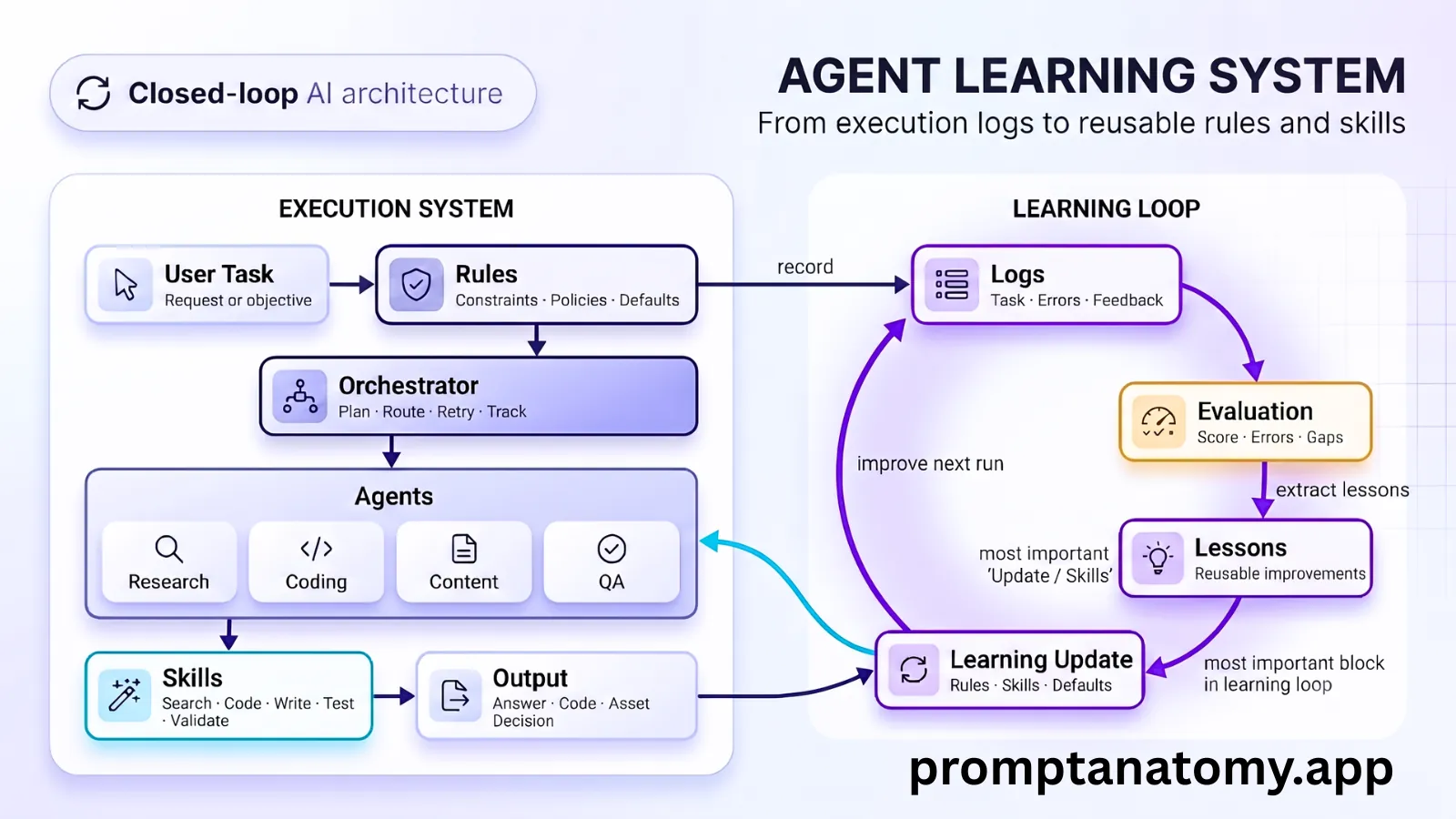
Prompt Anatomy cut over promptanatomy.info to Vercel production on 2026-05-29 (v1.4.0 in sister repo DITreneris/automation)—a free, no-account, five-locale static library (LT, EN, ET, LV, JA) at promptanatomy.info/en/ with eight org-analysis prompts and a copy-first journey. What made the launch repeatable was a closed-loop builder system we used while translating UI, UX, and prompt copy: Orchestrator plus Content, UI, QA, and Research agents on the execution side; logs, evaluation, lessons, and rule updates on the learning side.
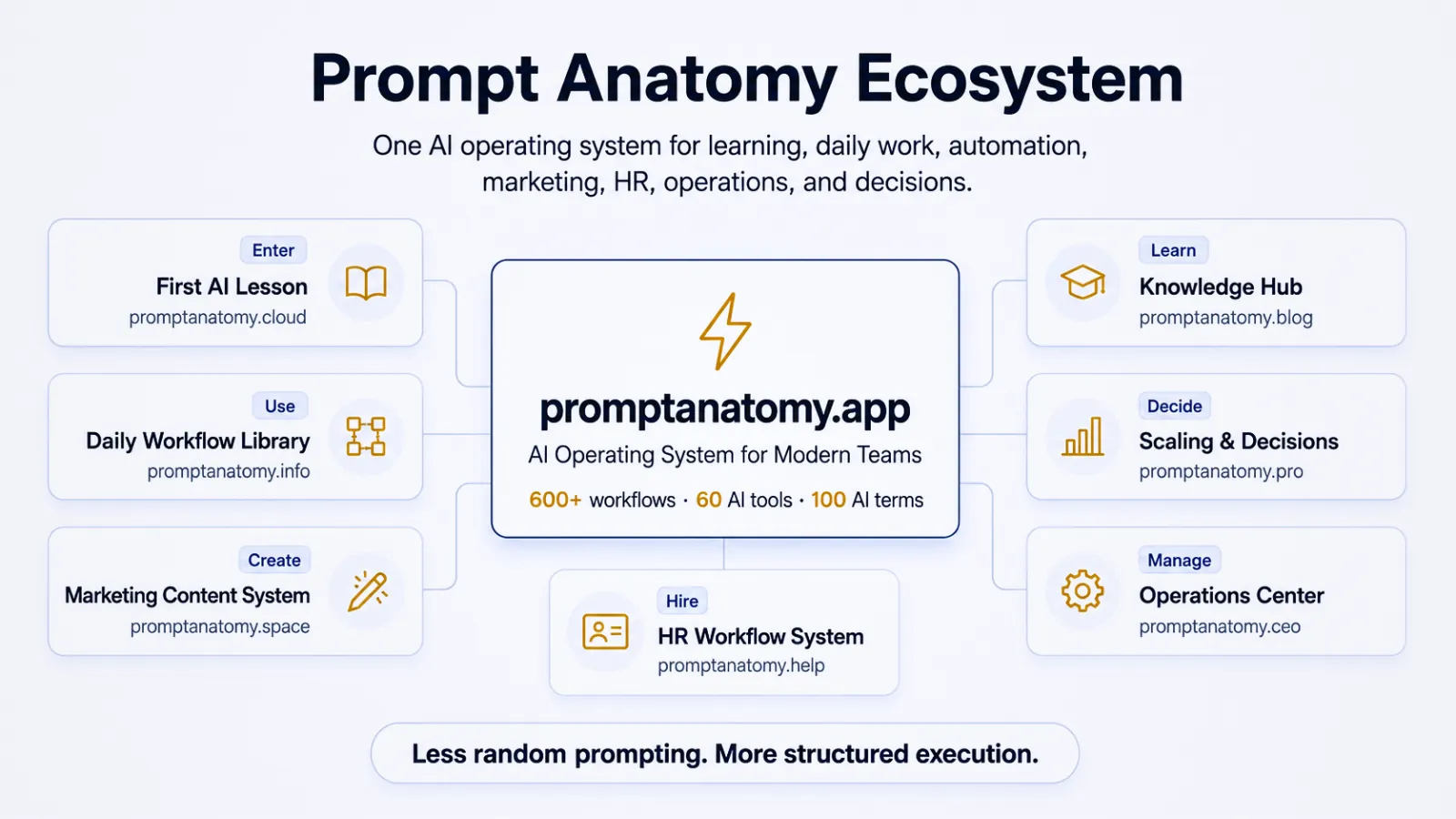
This field note covers what shipped and where .info sits beside governed implementation content on .blog. If you are mapping properties for the first time, start with The Prompt Anatomy Ecosystem Map. For the Enter spoke—send check before depth—see Quick Send Check First.
What promptanatomy.info is
promptanatomy.info is the Use spoke—not the knowledge hub, not training checkout, and not a vertical wedge like .online or .ceo.
It is:
- A free, no-account static library with paths for LT, EN, ET, LV, and JA
- Eight org-analysis prompts with bullet-proof META / INPUT / OUTPUT blocks per BULLET_PROOF_PROMPTS
- A copy → mark done → next prompt journey with progress in browser localStorage
- Assembly only—the library never calls an AI API; visitors paste into ChatGPT, Claude, or Gemini
It is not:
- An agent runtime, LMS, or enterprise workflow registry
- Proof of corporate AI maturity for procurement decks
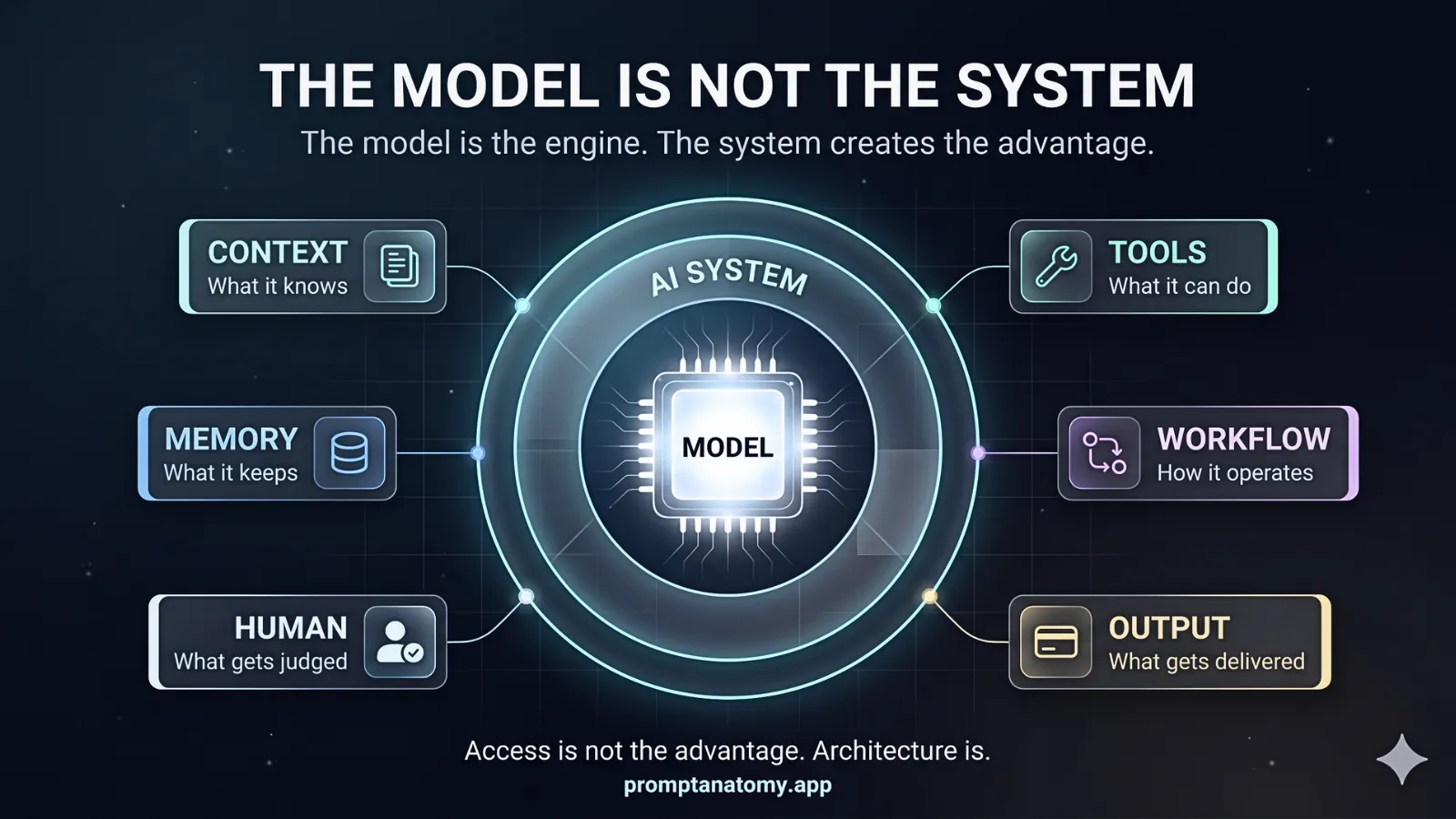
That separation mirrors a rule we repeat on .blog: the library is not the execution environment. See The Model Is Not the System. The agent loop on the hero runs on the builder side—localizing and hardening the product—not inside the user’s chat session.
Builder loop on the hero
The launch hero encodes a closed-loop agent learning system—not a production multi-agent graph customers run.
| Diagram block | Multilingual shipping on .info |
|---|---|
| Orchestrator (plan · route · retry · track) | Repo Orchestrator role—CI parity, locale gates, generate:et-lv diff checks per AGENTS.md |
| Content agent | Microcopy and prompt bodies per locale—library.js (EN canonical), library.lt.js, library.ja.js, generated ET/LV |
| UI agent | DS v2.0 tokens, library.css, lang dropdown, collapsible prompts 2–8, mobile-first polish |
| QA agent | structure.test.js (five-locale asserts), pa11y on /en/, /et/, /lv/, /ja/, lint:html across HTML pages |
| Research agent | MULTILINGUAL_STRUCTURE.md, hreflang rules, locale path parity |
| Learning loop | lessons/LESSONS.md—EN leaks, generator drift, hreflang bugs—fed back into rules |
Contrast with Agent Orchestrator Operating Model: that article defines the production org role for multi-agent workflows in your company. This diagram shows the builder system that localized UI/UX and prompt copy while keeping five locales aligned.
The locale pipeline
EN is canonical for shipping gates. ET and LV pages and JS generate from EN via npm run generate:et-lv; LT and JA stay manual but must pass the same structure and a11y asserts. After every EN edit, CI fails if generated ET/LV/LT JS diff is uncommitted—that is the Orchestrator enforcing parity, not goodwill.
| Locale | Path | Maintenance |
|---|---|---|
| EN | /en/ |
Canonical—en/index.html, js/library.js |
| ET | /et/ |
Generated from EN |
| LV | /lv/ |
Generated from EN |
| LT | /lt/ |
Manual—origin tone; must stay structurally aligned |
| JA | /ja/ |
Manual—prompt corpus in prompt-bodies-ja.cjs |
Local preview uses npx serve . -l 3000 without -s—SPA mode breaks locale paths. That rule landed in lessons after a bad preview session; the learning loop working as designed.
Curriculum order is the lesson
The eight prompts teach org context before daily depth—the same sequence Northline needed after the invented-statistic incident:
.info prompt |
Blog parallel |
|---|---|
| DI context check | Structured Prompt System Blueprint |
| Organization portrait | What Is Context Architecture |
| Role + KPI | Types of Prompts for Business Workflows |
| Core processes (Pareto) | From Prompts to Business Outcomes |
| Daily prompt library (prompt 7) | Handoff Rules Between Humans and AI |
Translating that curriculum into five locales forced the agent loop to treat prompt semantics and UI microcopy as one surface. A library that reads premium in EN but leaks English into ET footer links fails the same way a support agent leaks the wrong disclaimer. See 10 Signs Your Company Is Vibe Prompting when copy-paste feels ship-ready without review.
Premium SaaS craft without a backend
v1.4.0 shipped Design System v2.0 and interaction patterns that feel like a hosted product—without databases or inference:
- Token SSOT —
css/tokens.cssonly; semantic layers for link, action, focus, motion - Progressive disclosure — prompt 1 always open; prompts 2–8 collapsible with
#blockNdeep links - Copy journey — Copy CTA sits above “Before using”; successful copy auto-marks done and advances progress
- Mobile-first — lang dropdown, hover transforms only at
@media (hover: hover); toast respectssafe-area-inset
Premium feel here comes from interaction design plus test gates, not from calling an API. The builder agents earned that quality locale by locale—not in one EN-only sprint.
Builder patterns (for implementers)
Three patterns from the sister repo; deploy checklists stay in AGENTS.md and CONTRIBUTING.md:
- EN canonical + locale generator — edit EN first;
npm run generate:et-lvfor ET/LV; LT/JA manual with parity asserts. - Assembly ≠ execution — library constructs text; external tools run inference under user control.
- CI as Orchestrator —
npm testbundles structure, tokens, HTML lint, ESLint; pa11y runs per locale URL list.
Launch guardrails
Treat .info completion as orientation and daily habit, not proof of enterprise implementation maturity:
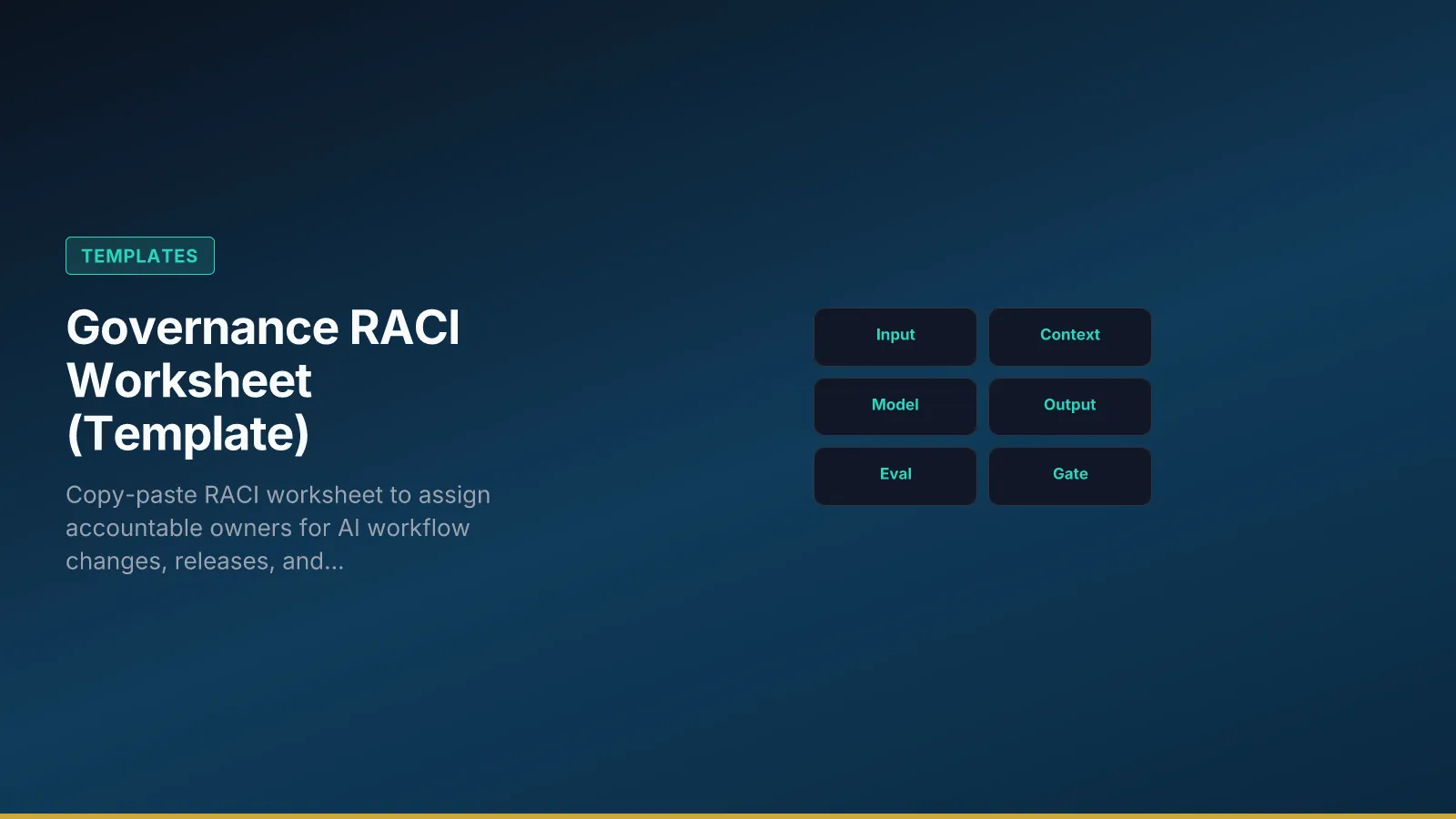
- Finishing eight prompts in five languages does not replace a documented workflow ID, RACI, or eval gate pack on your side.
- Do not paste library copy into procurement decks; link the relevant playbook on
.blogand cite pass rate, cycle time, or incident cost per AI Procurement Freeze. - Library host (
.info) and course host (.app) must stay distinct in analytics and CTAs—the same class of mistake as cross-domain webhook mismatches in Classroom Prompt Builder Launch.
Free ecosystem spokes complement training; they do not replace the paid foundation path (modules 1–6) on .app. See Shipping Prompt Anatomy for hub access and where Enter (.cloud) and Manage (.ceo) fit.
promptanatomy.info gives practitioners org-aware daily prompts in five locales. The job of this blog remains turning that curiosity into repeatable, owned AI workflows—with owners, eval gates, and audit trails that survive the next model swap.