Tools do not maintain themselves. Prompts drift, policy packs expire, connectors gain scopes, and new hires invent side-channel chats that bypass retrieval tags. Rituals beat one-off trainings because they keep workflows honest after launch—short, recurring forums with decisions and owners, not slide tours that end when the pilot badge is earned. If your team is new to the blog vs training app split, read The Prompt Anatomy Ecosystem Map first.
Rituals connect daily work to governance roles and risk cadence—Level 3 on the maturity ladder is not “we launched” but “we still review eval biweekly.”
Suggested rituals (cadence and purpose)
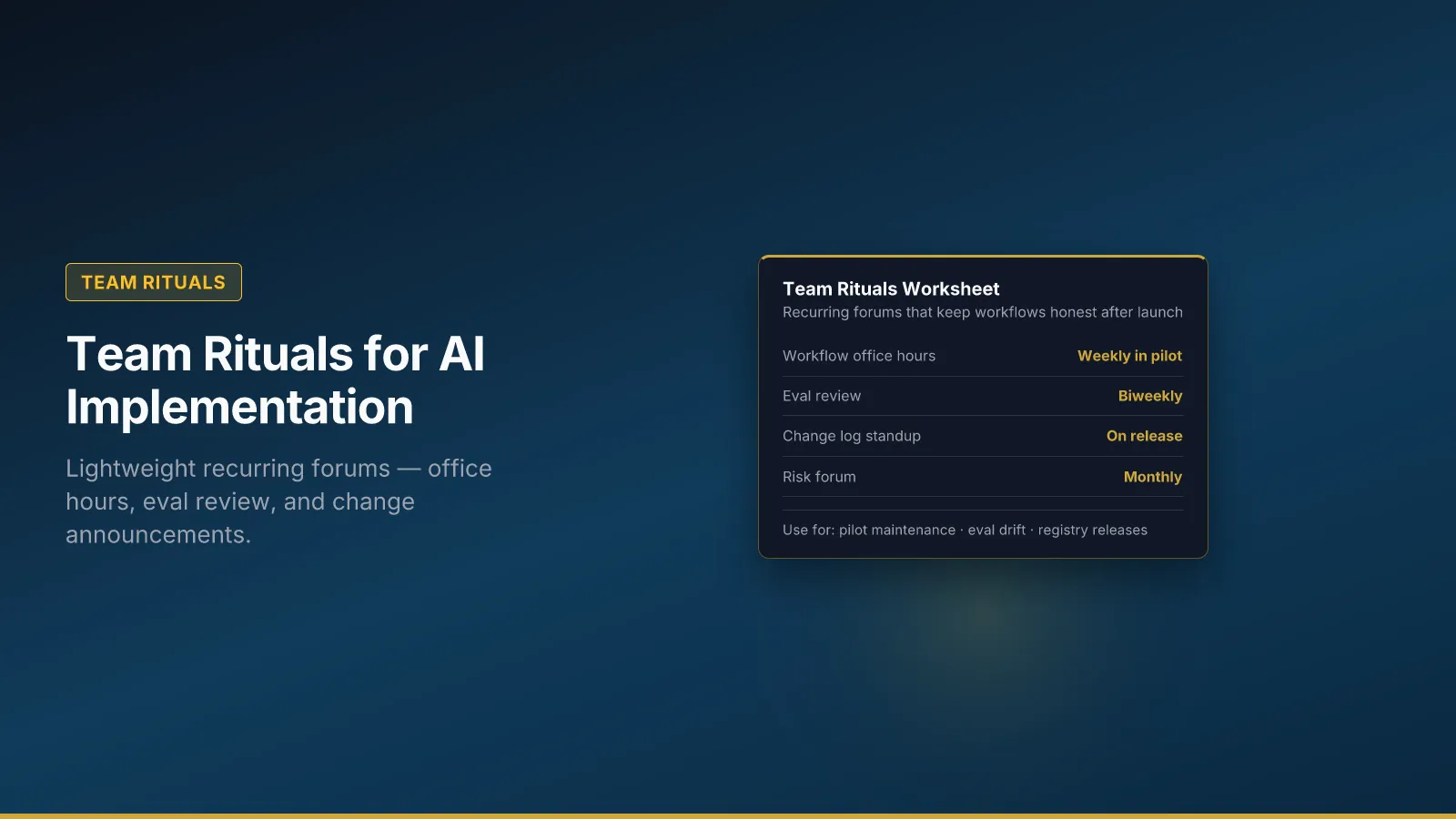
Recurring forums beat hero launches because they maintain versioned artifacts after go-live. The table below is a minimum set—add domain-specific rituals only when they produce decisions logged with owners, not additional status meetings.
| Ritual | Frequency | Purpose |
|---|---|---|
| Workflow office hours | Weekly in pilot | Unblock owners, capture friction |
| Eval review | Biweekly | Regressions before customers |
| Change log standup | When releasing prompt/context | Who needs to know |
| Risk forum | Monthly | Decisions, promotion, incidents |
Workflow office hours — process owner + IT + optional Legal slot. Bring real tickets, not hypotheticals. Output: canvas updates, new eval cases, boundary fixes—not “awareness.”
Eval review — publish pass rate, override themes, failed cases. Block promotion if biweekly trend dips below threshold even if monthly average looks fine.
Change log standup — fifteen minutes when registry version bumps: what changed, who approved, which environments pinned, which reps need Outlook re-training for snippet v4.
Risk forum — full agenda in the risk cadence article; rituals feed it metrics and incidents, forum feeds rituals actions.
Sample agendas (timeboxed)
Copy these into recurring calendar invites. If an item runs long, park follow-ups as owned actions—do not extend the meeting.
Weekly workflow standup (30 minutes)
| Time | Item | Owner |
|---|---|---|
| 0:00–0:05 | Open queue: blocked tickets, boundary denials since last week | Process owner |
| 0:05–0:15 | One real failure walkthrough (override cluster, eval miss, connector scope change) | Rotating facilitator |
| 0:15–0:22 | Canvas or registry deltas needed—prompt_id, context pack, eval case | IT + process owner |
| 0:22–0:28 | Decisions: approve, defer to forum, or assign spike with due date | Process owner |
| 0:28–0:30 | Capture actions in risk register; confirm next standup owner | Note-taker |
Output: at least one logged action with owner and due date—not “we will monitor.”
Monthly risk forum (45 minutes)
| Time | Item | Owner |
|---|---|---|
| 0:00–0:05 | Metrics rollup: eval pass rate trend, override themes, incident count | Process owner |
| 0:05–0:15 | Promotion requests: shadow → prod, new workflow IDs, policy pack bumps | Workflow owners |
| 0:15–0:25 | Open incidents and near-misses; audit replay gaps | Risk lead |
| 0:25–0:35 | Tool or connector changes touching customer data | IT |
| 0:35–0:42 | Retirements: deprecate prompt versions, sunset pilots | Forum chair |
| 0:42–0:45 | Vote: approve / hold / reject with named approvers in minutes | Risk lead |
Forum minutes link to audit trail fields so replay drills stay honest.
Quarterly implementation review (60 minutes)
| Time | Item | Owner |
|---|---|---|
| 0:00–0:10 | Maturity placement vs implementation ladder—what moved one level | Sponsor |
| 0:10–0:25 | Workflow portfolio: pass rates, outcome metrics, workflows retired vs added | Process owners |
| 0:25–0:40 | Governance health: RACI gaps, training debt, ritual attendance | Ops lead |
| 0:40–0:50 | Budget and tool inventory: duplicates, renewals, freeze exceptions | CIO / finance delegate |
| 0:50–0:58 | Next-quarter priorities: max two new workflow IDs or one major version bump | Sponsor |
| 0:58–1:00 | Confirm forum dates and eval review cadence for the quarter | Forum chair |
Quarterly review is where leaders decide sequencing—not whether AI is “important.” Skip it and rituals devolve into status theater.
Rules that keep rituals from becoming theater
Rituals fail when they become status updates without decisions. Time-box sessions, require one real failure narrative, and log owners in the risk register—the same register your risk forum reads. Vendor demos and generic AI town halls are not substitutes for eval review or change standups tied to workflow IDs.
Time-box to 30–45 minutes except monthly forum. Bring one real failure per session—near-miss, override cluster, boundary denial spike. Decisions logged with owner and due date in risk register, not “we will monitor.”
No vendor demos replacing failure review. No ritual without process owner present—they own follow-through.
Rotate facilitation so ops and IT both chair—prevents “IT-only AI club.”
Connecting rituals to artifacts
Ritual outputs must land in versioned artifacts or they evaporate. Standup decisions update the workflow canvas and eval cases in evaluation hooks. Change standup outcomes notify customer-facing teams when snippet or policy pack versions change—Outlook snippets and CRM templates are part of the workflow, not side channels.
Starting rituals without bureaucracy
You do not need a program office to start. Week one of pilot: schedule office hours and biweekly eval review before go-live, book six forum dates, and publish a one-page minutes template. When stakeholders push back on meeting load, cut generic awareness sessions—not forums tied to metrics and workflow IDs.
When team says “too many meetings,” cut generic AI town halls—not forums tied to workflow IDs and metrics.
Monday start: Put recurring invites on calendar with agendas in description. Assign note-taker rotation. First eval review uses last ten overrides—even if pilot day five.
Rituals maintain prompts, context, and ownership after launch—training alone does not.