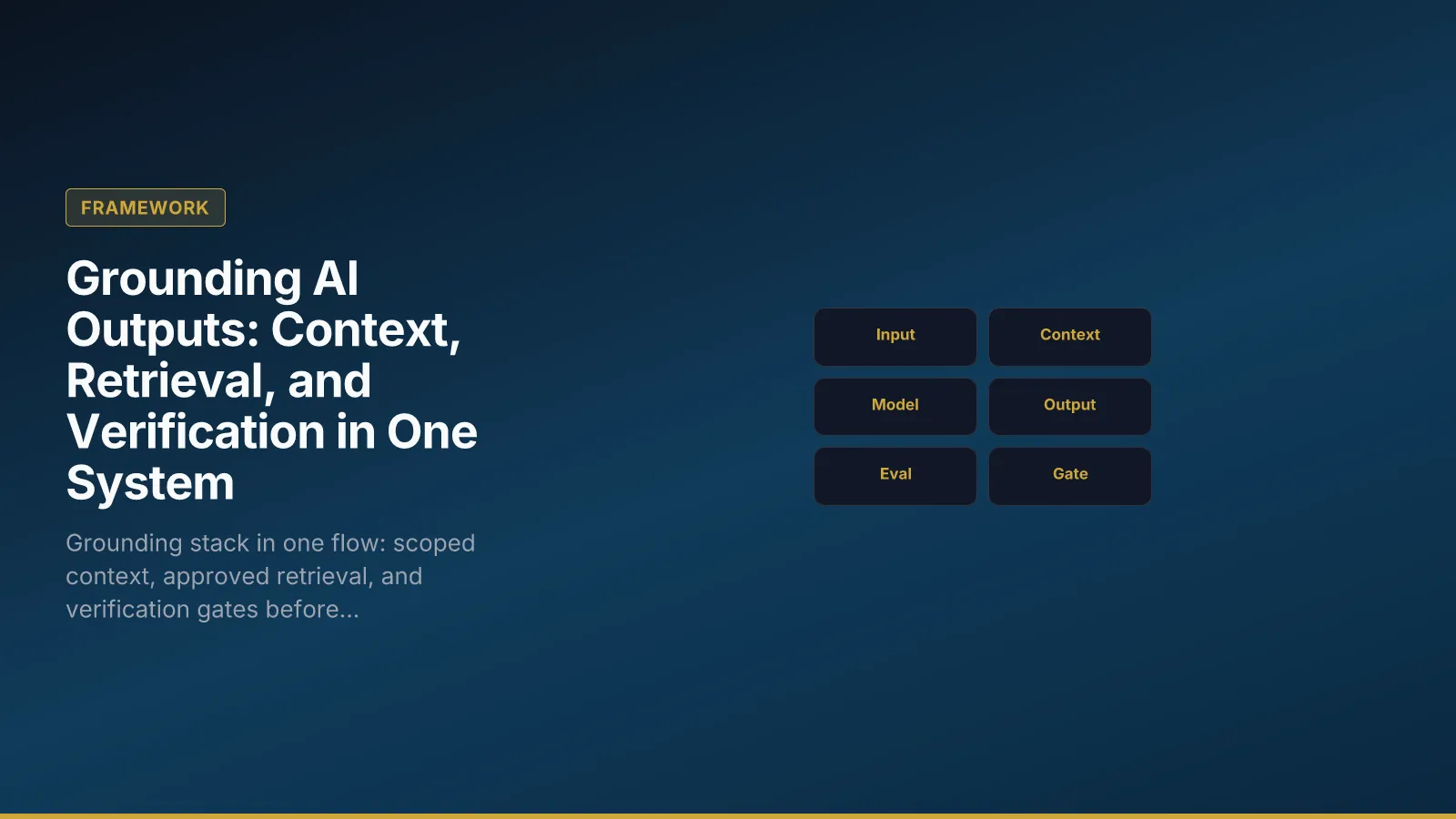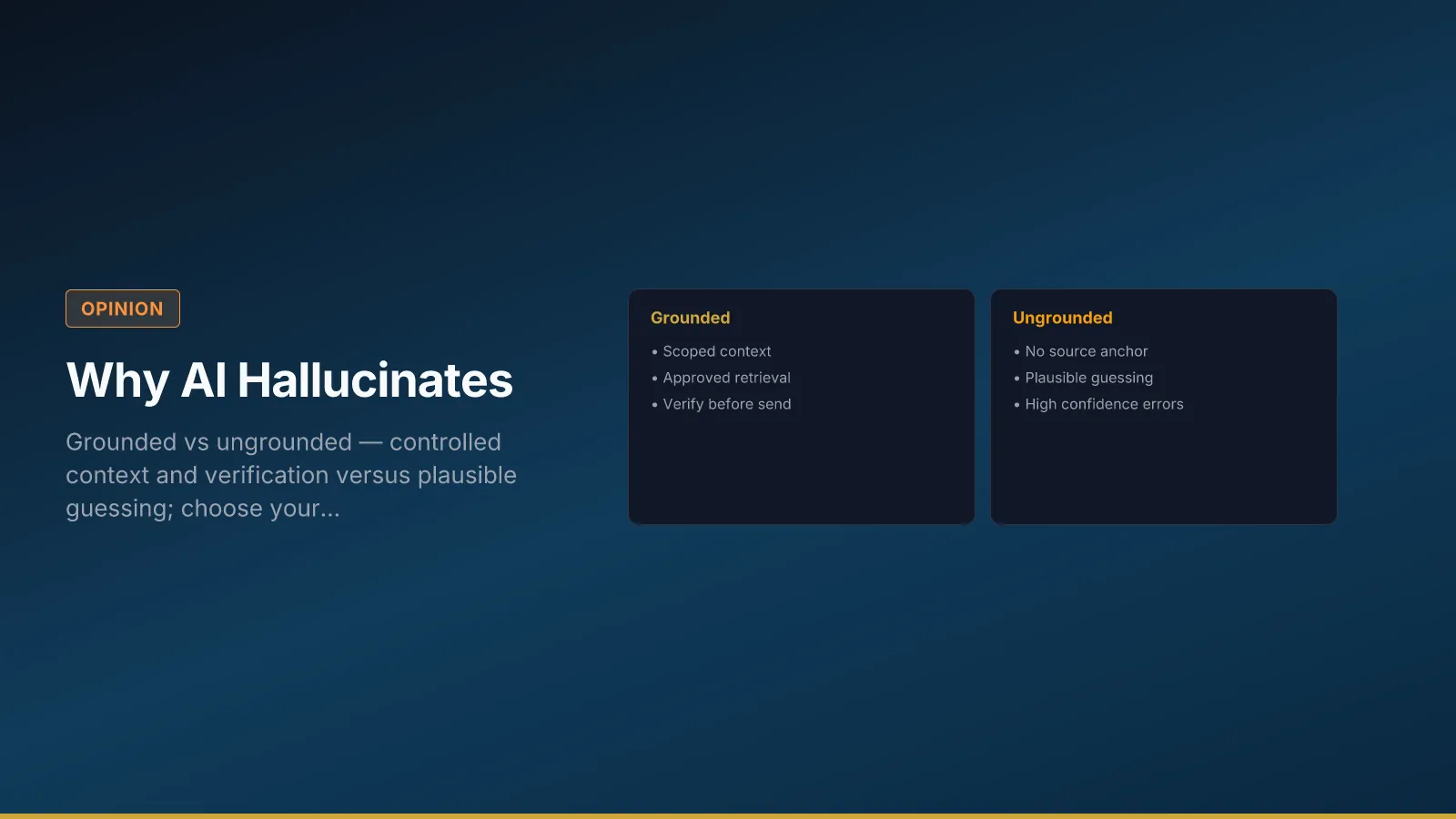
The hero is a split screen: grounded (controlled context, verification) versus hallucination (guessing what sounds right). The lesson in one line: AI predicts words; it does not verify truth. Hallucination is not a bug you eliminate with a premium tier — it is default behavior without a system around the model.
Visual primer — hub article: Grounding AI Outputs.
Use this page to orient your team, then follow the decision table below. Detailed checker design, human factors, and production architecture live in sibling articles — not repeated here.
Grounded is a design choice
Grounded means known inputs: approved snippets, tagged retrieval, policy packs with version IDs, denial rules on sensitive fields. Verification means checkers, human sign-off, or automated assertions before customer-facing send. None of that is automatic when you enable copilot in a browser.
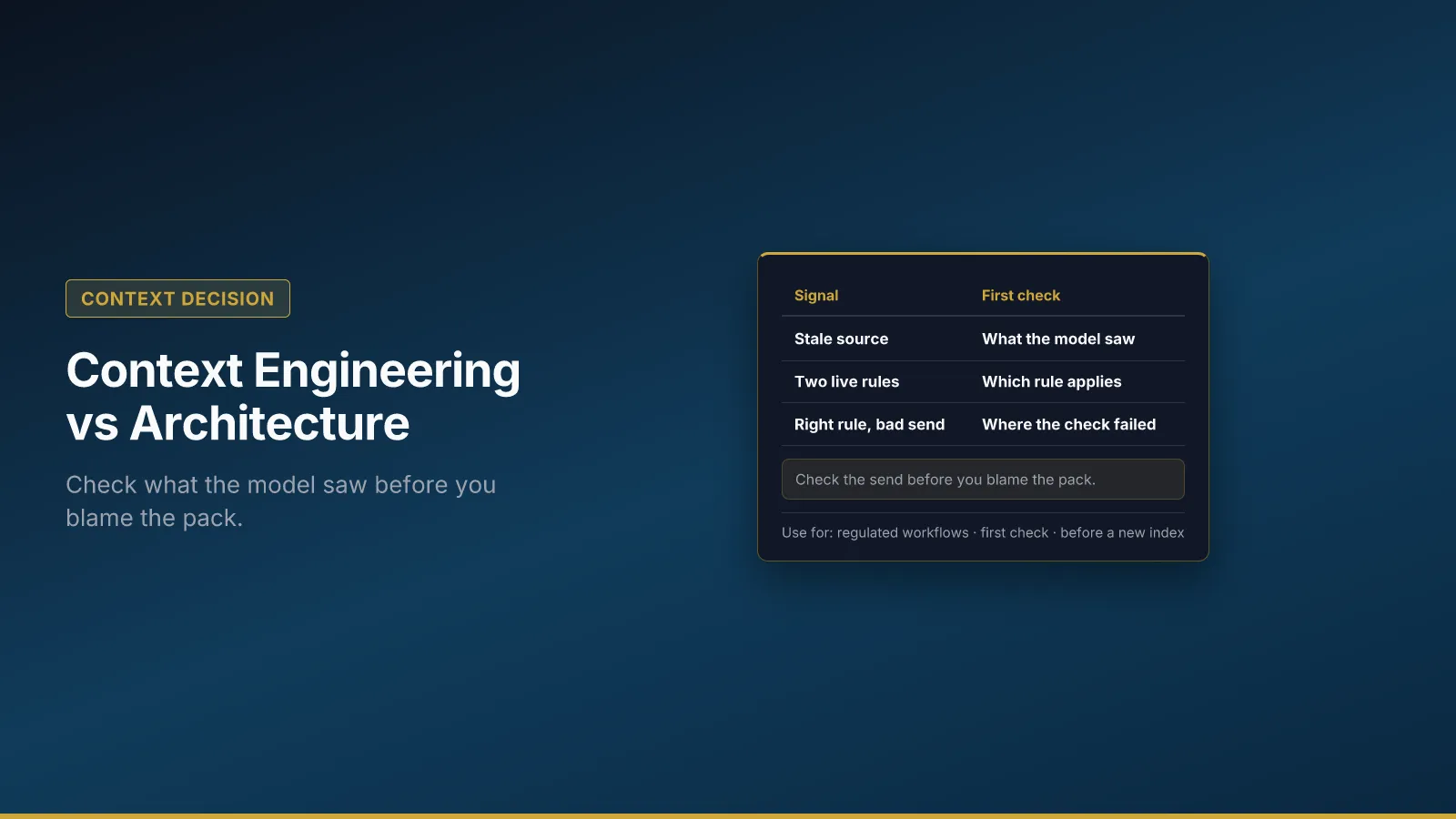
Teams say they want “accurate AI” but skip indexing scope, freshness rules, and eval cases that fail when a clause drifts. Grounding is operations — not a checkbox in a procurement deck. What Is Context Architecture names the layers that make grounding repeatable.
Ungrounded feels productive
Ungrounded generation is fast and fluent. That fluency relaxes reviewers — especially under queue pressure. Confidence tone is a language-model feature, not evidence of correctness. Legal often learns “plausible ≠ true” after the first wrong disclaimer ships.
Northline B2B added a held-out eval case after a fluent wrong enterprise pricing tier reached a customer inbox — tone and structure passed review; tier did not. The case now blocks promotion when citation miss rate rises, even if average CSAT looks fine.
Choose your next read
| If your failure mode looks like… | Read next |
|---|---|
| Fluent wrong answers; reviewers trust tone | When AI Hallucinates Confidence |
| Need unified context + retrieval + verify design | Grounding AI Outputs |
| Need gates before send / held-out cases | Evaluation Hooks for AI Workflows |
| Agents retrieve or call tools on their own | Data Boundaries for AI Agents |
| Need replay and incident evidence | Audit Trails for AI Workflows |
One eval case to add this week
Pick a regulated field your workflow touches — pricing tier, warranty period, jurisdiction-specific clause. Write one held-out case where the wrong but fluent value is plausible. If your current eval set would not fail that case, your grounding system has a gap — regardless of model SKU.
Model swaps do not replace architecture. The Model Is Not the System places generation inside workflow and governance — where grounding becomes repeatable instead of heroic.