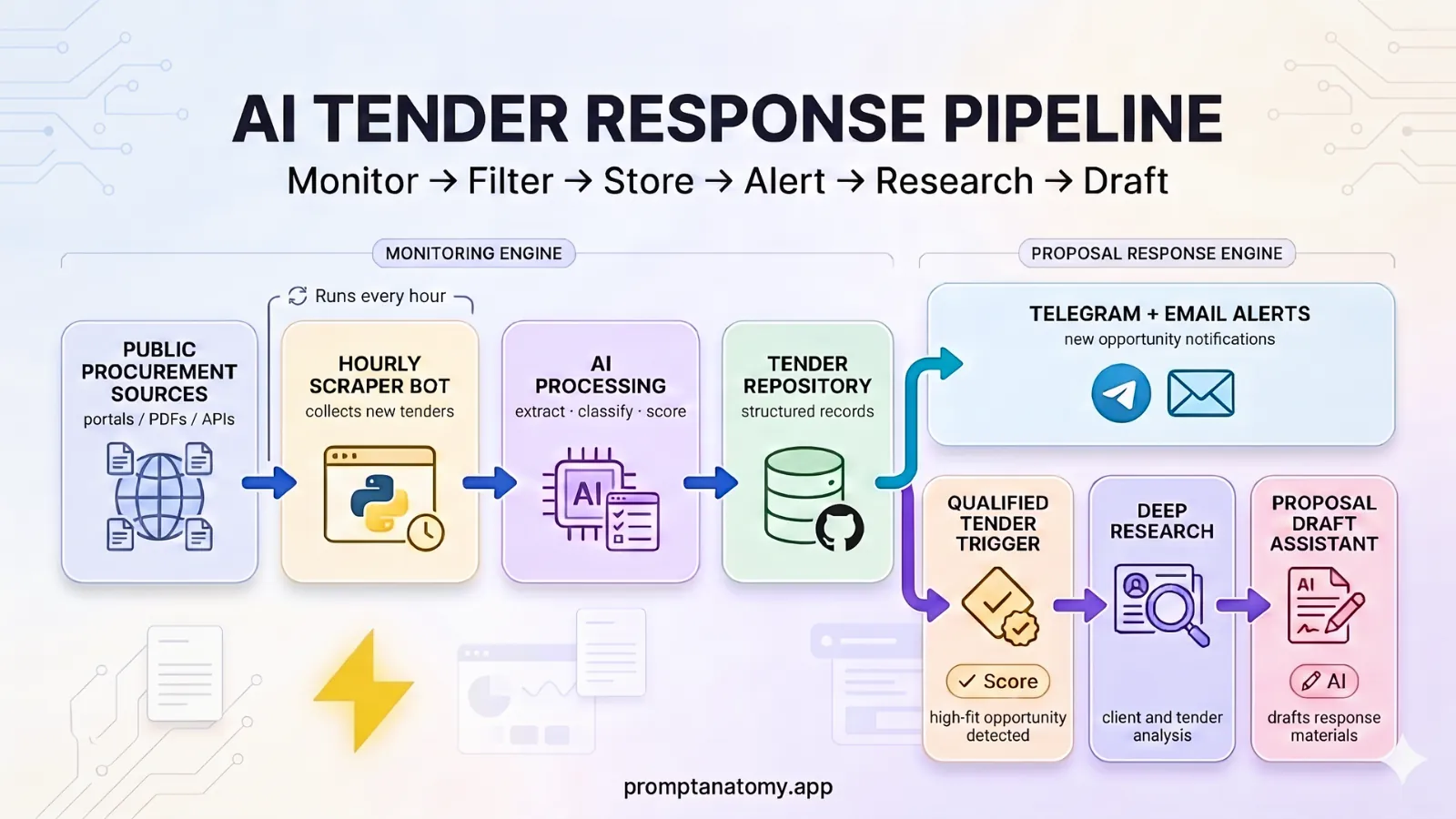
Anonymized composite (Northline B2B)—multiple implementations.
Tender and RFP work is document-heavy, time-bound, and unforgiving of invented clauses. A single long prompt cannot hold evaluation criteria, mandatory sections, approved boilerplate, pricing rules, and indemnity limits at once—models will still produce fluent unacceptable terms. A pipeline beats a mega-prompt: staged steps with retrieval from tagged sources, compliance scan, and human assembly before any PDF leaves the building.
This playbook is the legal/compliance depth companion to proposal workflow design in how to design an AI agent workflow and the system frame in the model is not the system. No auto-submit to portals in v1; no external send without Legal sign-off on indemnity, SLA, and data-processing sections.
Pipeline stages (what happens in order)
Each stage has an owner and exit criteria—skipping a stage to meet deadline defaults to no-bid, not rushed send.
Intake parses deadline, mandatory sections, and evaluation criteria into structured fields. Human confirms parsing—OCR and LLM extraction err on dates and annex references. Output: section checklist with due dates.
Retrieve pulls only approved wins, boilerplate blocks, and pricing rules tagged approved in repository. Deny unreleased spreadsheets and draft wiki pages—same default-deny mindset as data boundaries.
Draft generates section-by-section with citation to source IDs (LIB-B-12), not one 40-page paste. Context stays bounded; eval can target trap sections.
Compliance scan runs keyword and clause checks; flags gaps for Legal queue. Automated scan does not replace Legal accountability on indemnity and DPA.
Human assembly — proposal owner edits, Legal reviews flagged sections, final PDF exported with reviewer IDs logged. Portal submission manual until Legal signs.
Clause checklist (legal gate)
Legal gate is a hard stop, not a comment thread after export.
| Section | Check | Fail action |
|---|---|---|
| Indemnity | Matches approved library clause ID | Block section; Legal rewrite |
| SLA penalties | Within approved bounds | Flag for exec review |
| Data processing | DPA template attached | Stop pipeline |
| Pricing tier | Matches CRM band | Human verify |
| Subcontractor disclosure | Required if RFP asks | Insert boilerplate B-12 only |
Eval set must include trap clauses—unlimited liability, prohibited data residency, free-form indemnity favoring buyer—that models tend to accept politely. Fail closed in CI smoke where possible via evaluation hooks.
Redacted section example (right vs wrong)
RFP asks: “Describe indemnification for third-party IP claims.”
Wrong (model-only): Generic favorable indemnity not in library—reads well, fails audit.
Right (pipeline): Draft pulls clause-indemnity-2024-EU-v2; citation LIB-B-12; export blocked until Legal reviewer ID attached. Log retrieval IDs per audit trails.
Teach proposal owners to spot “fluent wrong” without reading every word—checker flags unsupported clause IDs.
Controls across registry, eval, and agents
Version every boilerplate block in structured prompt system registry—prompt IDs per section template, not one growing doc.
Log retrieval IDs and template_hash on each section generation. Run eval on held-out RFP set before model or retrieval index changes.
Intake parsing may use agent patterns from agent workflow design—orchestrator hands off section drafts with handoff schema; human assembly remains mandatory.
Forum promotion follows risk review cadence when increasing auto-retrieval scope.
Operating the pipeline under deadline pressure
Time-box Legal review SLA; missed deadline defaults to no-bid, not stripped-down Legal review. Section-by-section generation beats monolithic context—cost and error rate both improve.
Never train or retrieve on unreleased pricing—tag sources approved only; violations are governance incidents, not model bugs.
Monday start: List mandatory RFP sections and boilerplate IDs. Add three trap clauses to eval set. Confirm portal submission manual until Legal signs PDF.
Tender AI works when only approved content enters drafts and legal sign-off stays mandatory—every time.