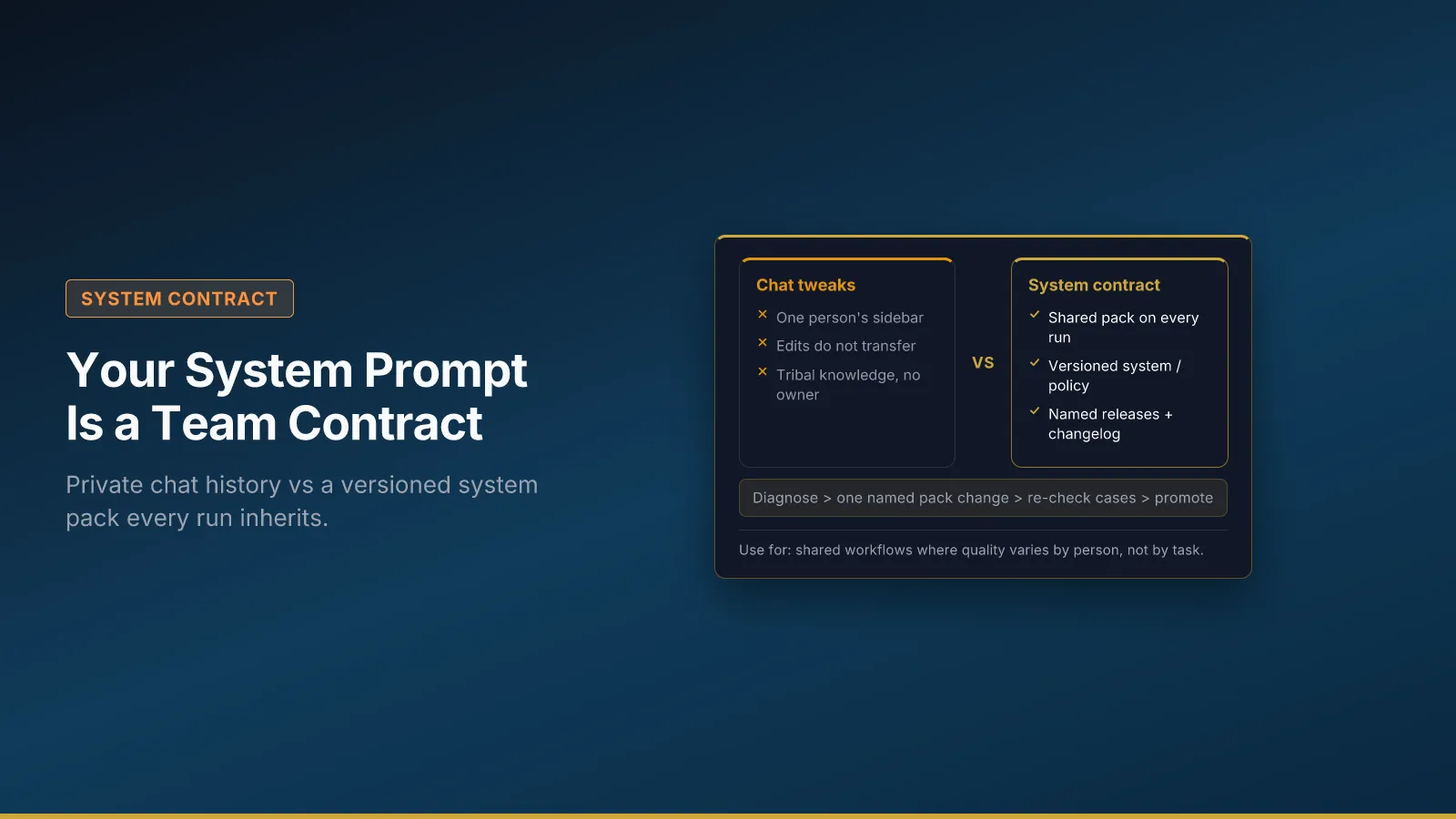
Teams keep polishing personal chat history while shared quality stalls. The hero contrast is simple: chat tweaks live in one sidebar; a system pack is versioned text—refuse rules, output shape, review language—that every run on that workflow inherits. Changing that layer is a release, not a private experiment.
Sidebar tweaks vs the shared layer
| Private chat tweak | Versioned system / policy |
|---|---|
| Improves one person’s thread | Applies to every run on the workflow |
| No owner or changelog | Named owner, version, reason |
| Hard to replay after staff rotate | Replayable with the same pack pin |
| “Ask Jordan” tribal knowledge | Shared failure vocabulary |
High leverage is not a longer system message. When quality varies by user but not by task, invest in workflow and ownership before stacking instructions—see Prompt Engineering vs AI Workflow Engineering. The system/policy role belongs in a versioned pack, not an ever-growing mega-prompt; Types of Prompts for Business Workflows separates that layer from task and checker text.
Length is not the point
There is no perfect size in kilobytes or characters. Budget in tokens: put refuse rules and output shape early, short enough that task text and evidence still fit—see Tokens and Context Window Limits when overflow drops early rules. A 500 KB “bible” usually signals a missing workflow split, not maturity.
Smaller local stacks (Gemma via Ollama) often need stricter, shorter, earlier rules; validators and reject paths beat another paragraph. Your overlay cannot erase model priors. When polish no longer moves held-out cases—or the model still seeks the same failure—stop rewriting the essay. Change model, add retrieval or a checker, or narrow the job.
Worked example — Critique Agent
On the open sister repo DITreneris/agent (Critique Agent), the system layer improved across releases. The lesson is not the full prompt text—it is which aspects made learning comparable. Details and history live in the repo CHANGELOG; three aspects matter here:
- Output shape — “Accepted” means the same sections every run, not fluent critique that looks good once. That discipline is what Critique Agent v1.0 made explicit before persist.
- Refuse / reject path — Invalid output is not saved as success. Failures stay comparable, so the next system-layer edit has a clear before/after.
- Changelog discipline — System-layer edits ship as releases with reasons, not casual chat edits that become silent defaults.
Pipeline measurement and field-test trust stay in the Critique Agent series; this primer only needs the shared-layer lesson. For how system-level configuration maps to organizational memory, see Three Types of AI Memory.
Improve the shared layer as a loop
Treat upgrades like code: diagnose the failure mode → make one named change to the shared pack → re-check a small case set → promote. If the metric does not move, the next investment is rarely more prose. Register the pack with an owner and eval hook when the workflow is production—Prompt Registry Playbook—or structure the write layer with The Six-Block Prompt System when Meta and Quality blocks carry the rules.
Control without a shared layer is still chaos vs control dressed as expertise. When you need the operating pipeline behind the example, start with Critique Agent v1.0—not another personal rewrite of yesterday’s best thread.