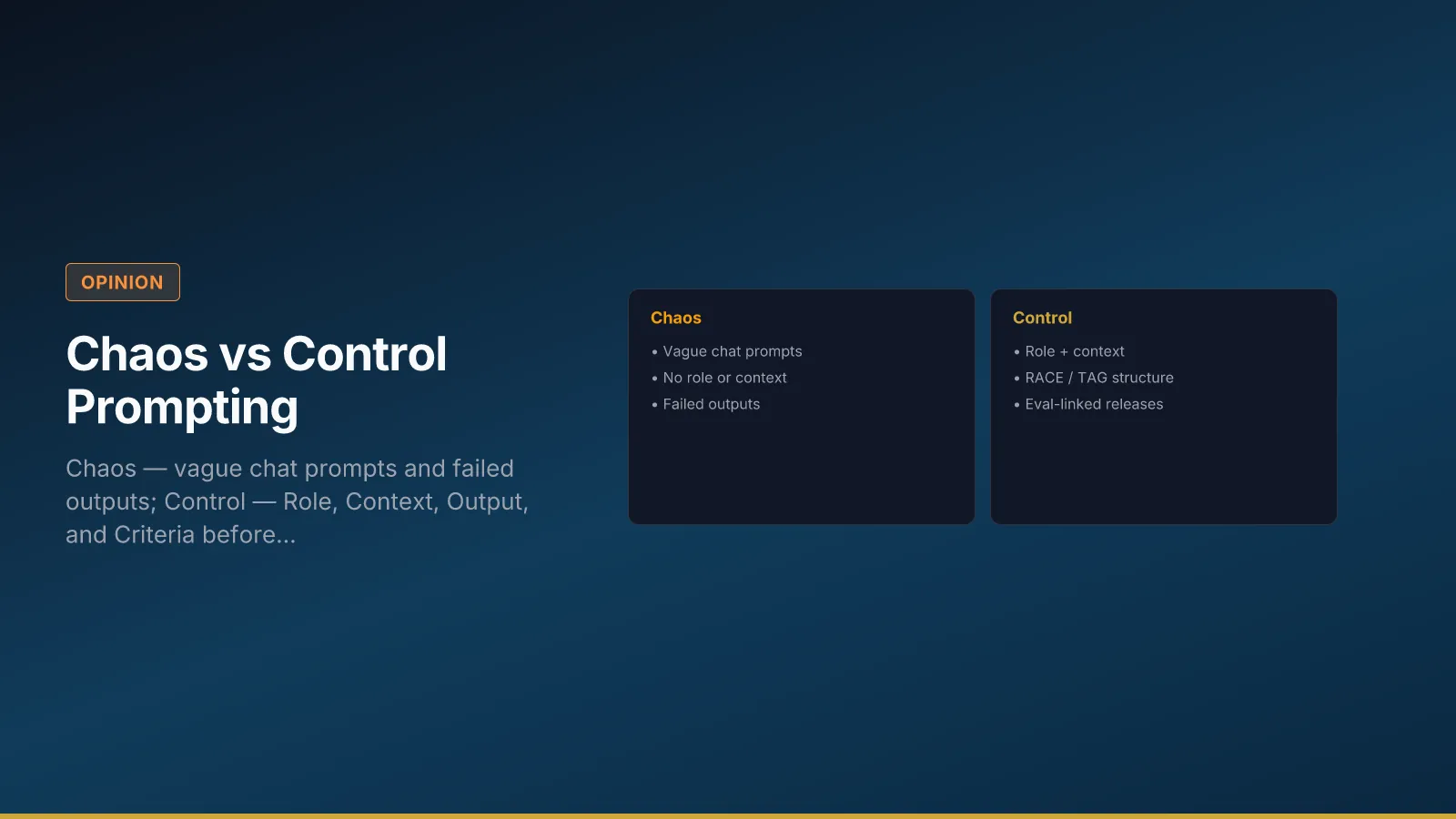
The headline on the poster is uncomfortable and true: AI is not random — your input is. The left side is chaos: “make it better,” “try again,” scattered asks, red Xs on outputs. The right side is control: Role, Context, Output, Criteria feeding a result that matches spec. Same model family; different contract.
The visual is not arguing that models are perfect. It argues that variance you blame on “AI mood” is usually missing fields — who may act, what evidence counts, what shape the answer must take, and what fails the run before a human ships. Once those fields exist, retries drop because the first pass is scoped. When the shared system layer is the contract—not a private chat tweak—see Your System Prompt Is a Team Contract.
What chaos looks like in operations
Chaos is not stupidity — it is unbounded experimentation under deadline. Marketing pastes a brief; support rewrites three times; Legal discovers inconsistent clauses after send. Everyone blames the model. Nobody owns a versioned template, so the best prompt lives in someone’s sidebar history.
Chaos shows up in metrics as high retry rate, inconsistent CSAT on the same task type, and tribal knowledge (“ask Jordan, they get good answers”). It also shows up in audit answers you cannot defend: no prompt version, no context hash, no record of who approved policy text. If your organization scores high on 10 Signs Your Company Is Vibe Prompting, chaos is likely systemic — not a training problem for individual prompt writers.
Executives sometimes fund “prompt training” while leaving tools, data paths, and approval rules untouched. Training helps individuals write better one-off asks; it does not replace workflow IDs, registry rows, or eval gates. Until those exist, chaos will return the Monday after the workshop.
What control means (four fields)
| Field | Question it answers |
|---|---|
| Role | Who is the model acting as — and what must it refuse? |
| Context | What approved facts may it use this run? |
| Output | Format, length, fields, tone boundaries |
| Criteria | Pass/fail checks before a human ships |
Control is not “longer prompts.” It is fewer degrees of freedom per step — aligned with workflow stages, not one mega message.
Each field maps to ownership. Role and refusal rules often sit with Legal or the process owner. Context packs sit with IT and domain leads. Output contracts sit with ops. Criteria sit with quality or risk — and should connect to eval cases, not vibes. When a step only needs two fields (e.g. internal brainstorm), document that explicitly so production steps do not inherit demo looseness.
A practical test: can a new hire produce an acceptable draft using only the template and approved context — without asking who “usually” prompts it? If not, you have chaos dressed as expertise.
From poster to production
Posters become systems when templates live in a registry with owners and eval sets — see Structured Prompt System Blueprint. When prompts differ by step (policy vs task vs checker), see Types of Prompts for Business Workflows — including how that article’s four prompt roles map to the PA stack taxonomy in the hero for types of prompts.
Production control also means separating steps in the workflow canvas: retrieval before generation, checker before send, human gate before customer-facing channels. The four fields are the minimum contract per step — not one combined system message that grows every time someone adds a rule. Version templates when criteria change; re-run smoke eval before promoting to pilot.
Map the poster’s four labels to rows in your registry (prompt_id, version, owner, eval_set) so “control” is searchable in incident review — not only visible on a training slide.
Go deeper
Control without measurement drifts. Add Evaluation Hooks for AI Workflows before you scale usage — and 10 Signs Your Company Is Vibe Prompting if chaos is org-wide, not individual. For the control ladder from tokens through retrieval, see Five Levels of AI Control — chaos is what the bottom rungs look like when skipped.