Unstructured chat produces drafts and inconsistent customer-facing language. Sponsors do not fund one-shots; they fund outputs that survive review, audit, and handoff. The six-block prompt system is how Prompt Anatomy teaches teams to write that structure before they argue about models or tools.
If you need the operating stack—outcome through governance—start with Prompt Anatomy Foundations. If you need where reading vs practice live, see The Prompt Anatomy Ecosystem Map. This article defines the write layer.
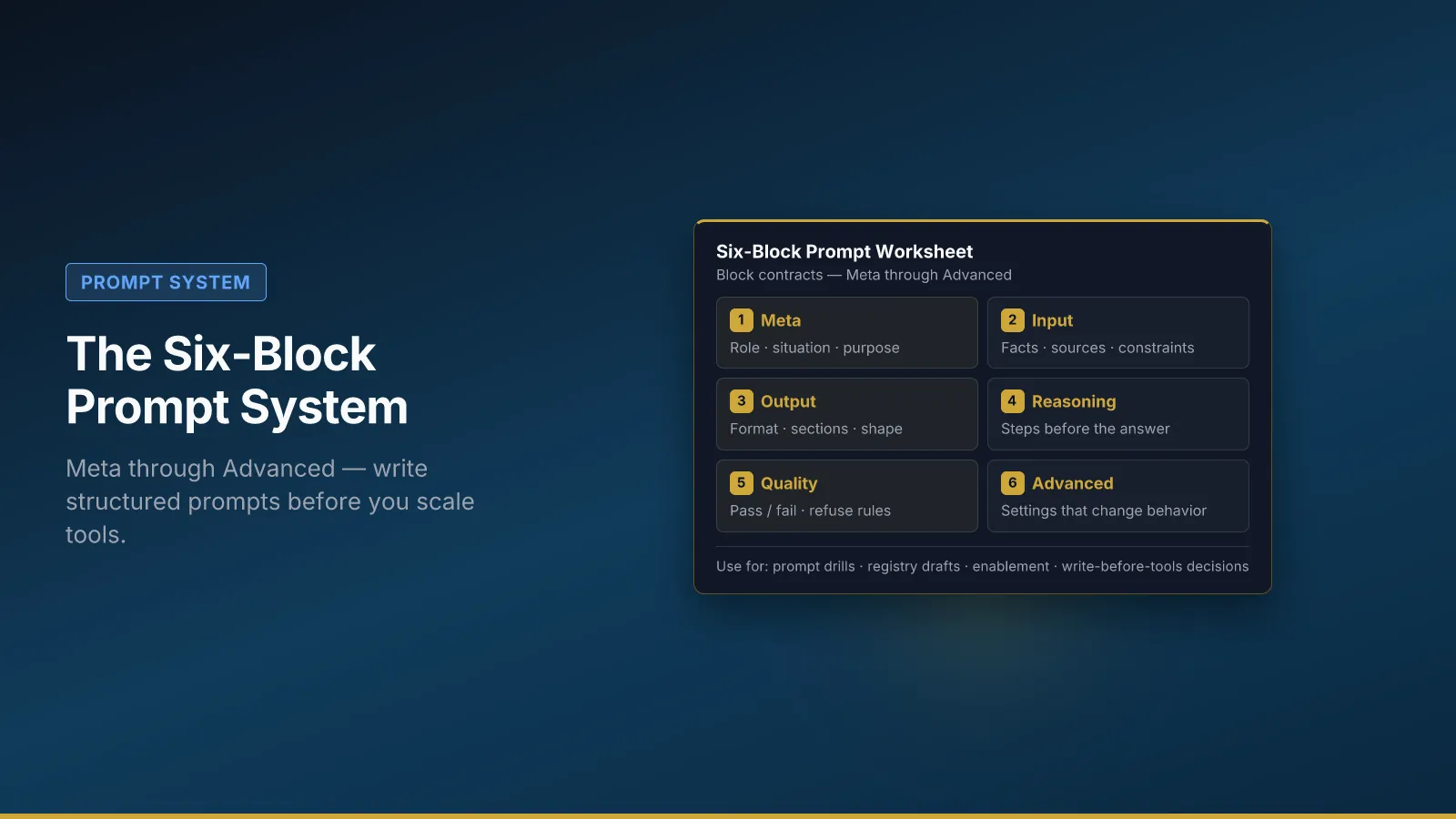
The six blocks
Treat each block as a named contract, not a heading. Skip a block and you discover the gap in production review, not in the demo. Reviewers reject by missing block name—wrong voice, invented facts, or no refuse rules—instead of arguing about “tone.”
| Block | What you specify | Failure if missing |
|---|---|---|
| Meta | Role, situation, and purpose | Generic tone; wrong stakeholder voice |
| Input | Facts, sources, and constraints the model may use | Invented numbers; silent policy violations |
| Output | Format, sections, length, and delivery shape | Unusable walls of text; wrong artifact type |
| Reasoning | Steps or checks before the final answer | Jump-to-conclusion drafts; weak trade-offs |
| Quality | Pass/fail criteria and what to refuse | Confident wrong answers ship unchecked |
| Advanced | Tool or model settings that change behavior | Drift when temperature, tools, or modes differ |
The blocks are the anatomy of a designed prompt artifact. They are not a substitute for a prompt registry ID, an eval case set, or a RACI—those live in The Prompt Registry Playbook and governance posts.
Northline example — support reply
Northline B2B (composite) needed a support reply that named the product tier, refused inventing SLA dates, and ended with one clear next step. A six-block draft looked like this:
- Meta: Senior support writer for Northline B2B; calm, precise; goal is a customer-ready email.
- Input: Ticket summary, product tier, known outage window from the status page; do not invent dates.
- Output: Subject line + three short paragraphs + one CTA bullet; no marketing upsell.
- Reasoning: Confirm tier → check status facts → draft → self-check against Quality.
- Quality: No invented SLAs; tier name exact; CTA is one action only; if facts missing, ask one clarifying question instead of guessing.
- Advanced: Prefer deterministic drafting; no web browse unless status URL is provided in Input.
That structure turns “write a nicer reply” into an artifact reviewers can reject for a named reason. Paste the same six fields into the Six-Block Prompt Canvas for wiki and registry drafts. Practice loops that force fill-run-check on the same pattern live on promptanatomy.app after purchase—not as a slide deck.
Six-block vs RACE/TAG vs registry
Teams confuse three tools. Keep their jobs separate: writing structure, lighter task frames, and production ownership are not interchangeable.
| Tool | Job | Use when |
|---|---|---|
| Six-block system | Write a complete prompt with quality and settings | Teaching structure; drills; capstone prompts |
| RACE / TAG | Choose a lighter frame by task shape | Communication drafts or role-action tasks—see Prompt Frameworks for Business |
| Prompt registry | Version, own, and release production text | Live workflows with eval-linked promotion |
RACE and TAG can sit inside a six-block Meta/Output pair when the task is smaller. Registry rows should carry a stable ID and eval link even if the body was authored with six blocks. Do not declare a company-wide “winner” framework and skip owners.
Where practice fits
Shipping Prompt Anatomy describes the hub: plans, checkout, and module progress on promptanatomy.app. The Anatomizer on the marketing site teaches a five-part shape; Foundations teaches the six-layer ops stack; six blocks teach writing. Mixing those layers causes teams to buy training when they need a RACI—or to paste Anatomizer exports into production without owners.
Standardize team practice on promptanatomy.app when the same write-and-check loop is required. Keep governed workflows, eval hooks, and audit trails documented on this blog.
Guardrails
- Completing modules or earning a practice certificate does not replace a workflow ID, eval gate pack, or change log on your systems.
- Do not paste training copy into procurement decks; cite pass rate, cycle time, or incident cost on owned workflows.
- Prefer one Northline-style worked example in your registry over twenty unlabeled chat wins.
Next: paste the blocks into the Six-Block Prompt Canvas. Shared drills: promptanatomy.app/#pricing.