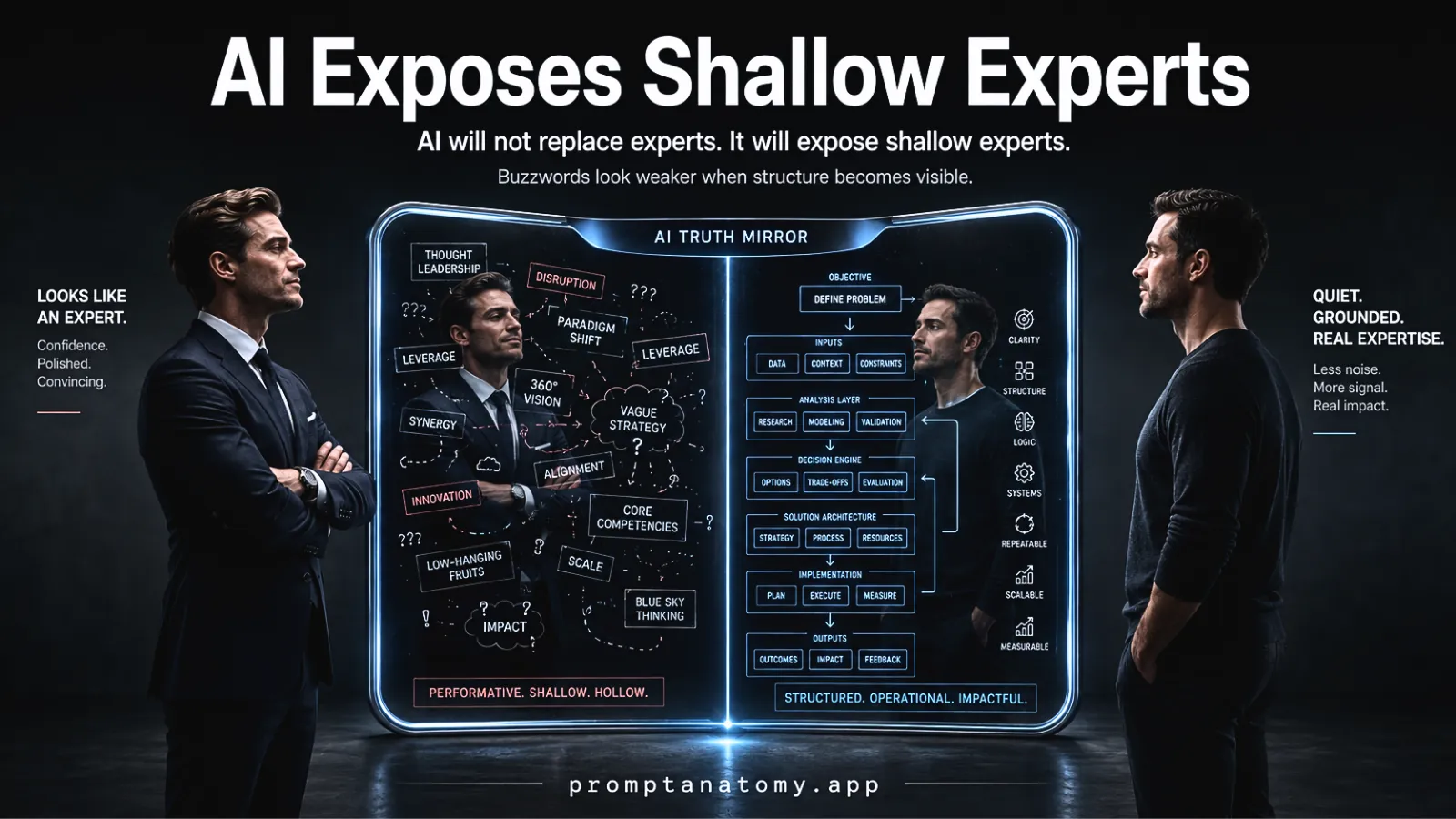
The poster asks a uncomfortable question: AI exposes shallow experts. Two figures look credible outside the mirror; inside, one reflects buzzwords, the other a flowchart — objective, inputs, analysis, decision, outputs. Your stack (tools, integrations, prompts, forums, logs) is which reflection you are building.
This article is a scorecard, not a symptom list. 10 Signs Your Company Is Vibe Prompting names organizational patterns; this audit scores artifacts you can verify in fifteen minutes—owners, eval sets, replay logs—before a steering meeting or renewal.
Scorecard companion — for procurement rules see Your Company Does Not Need More AI Tools.
This audit scores rituals and artifacts, not vendor logos. Complete it before the next steering meeting or tool renewal.
Performative vs operational (quick read)
| Signal | Performative | Operational |
|---|---|---|
| What changed last month? | New tool trial | Prompt/context version with eval diff |
| Who answers “why did we send that?” | Unclear | Owner + log fields |
| Quality measure | Anecdotes | Held-out pass rate |
Performative is not stupidity — it is unstructured confidence. Operational is boring on slides and valuable in audits. Data boundaries and AI risk review cadence are operational markers when minutes tie to version bumps.
10-item scorecard (0–2 each)
Score 0 = absent, 1 = partial/ad hoc, 2 = documented and owned.
| # | Item | 0 | 1 | 2 |
|---|---|---|---|---|
| 1 | Named workflow owner for highest-risk AI assist | |||
| 2 | Workflow ID on canvas for that flow | |||
| 3 | Held-out eval set with pass-rate trend | |||
| 4 | Prompt/context version in registry or changelog | |||
| 5 | Sample incident replay (inputs + output + versions) | |||
| 6 | Retrieval allow/deny documented | |||
| 7 | Tool allow list if agents/connectors exist | |||
| 8 | Risk forum cadence with decisions logged | |||
| 9 | Failures become new eval cases within a week | |||
| 10 | Sponsor metric tied to workflow (not “usage”) |
Total /20
| Band | Score | Interpretation |
|---|---|---|
| Performative | 0–8 | Tools and decks outrun architecture — freeze sprawl |
| Transitional | 9–14 | One workflow maturing — double down before expanding |
| Operational | 15–20 | Ready to expand scope with forum approval |
Worked example — composite team at 8/20
A mid-market ops team scored 8: they had copilots in support and sales, quarterly “AI council” slides, and high license adoption. They lacked workflow IDs, eval sets, and replay logs. Owners were “everyone and no one.”
90-day plan they adopted:
| Weeks | Action | Owner | Exit criteria |
|---|---|---|---|
| 1–2 | One workflow on AI workflow canvas — support-reply-v3 only |
Support ops | Canvas complete, denied data named |
| 3–4 | Twenty held-out cases; smoke gate in CI | Engineering + ops | Baseline pass rate recorded |
| 5–8 | No net-new tools; registry row for task framing | Process owner | Prod pin + changelog |
| 9–12 | Risk forum promote/hold on metric + eval | Governance | Re-score target 14+ on this rubric |
Week 6 checkpoint: if pass rate below 85%, pause expansion and add override-driven eval cases—same discipline as Northline Part 2. Week 12: tie sponsor deck to Measuring AI Workflow ROI scorecard rows, not license counts.
Re-score at day 90. Target 14+ before second workflow or agent tooling.
What to do with the score
0–8: Run 10 Signs with leadership; invoke procurement freeze if sign count ≥7.
9–14: Do not buy net-new tools; invest in registry, eval, and boundaries for the workflow you have.
15–20: Expand scope with evidence — The Model Is Not the System for architecture, Measuring AI Workflow ROI for sponsor decks.
Architecture beats another logo. Honest scores hurt once; vague scores hurt every quarter.