One Agent and Four Bounded Video Tools names the runtime. The agent is a Cursor session on this machine. It edits the project, calls ElevenLabs for voice, and renders with Remotion. A failed script returns a log. The session proposes a fix. I still authorize the stills and the upload. This part is what those scripts actually measure. The channel at youtube.com/@MrBulletLt has about 17.9 million views. Years of hearing a bad stem is why a 50-millisecond click counts as a failed check.
Audio and caption evals: beat-level timing, AAC priming clicks, and scribe_v2
Years of cutting music videos train your ear to refuse a clipped consonant or a late subtitle. When we wired scripts/voiceover.mjs as the first automated gate in our evaluation hooks for AI workflows, we found three failure modes that a human would only notice after rendering.
First, after the pre-API <= 2.6 words/sec check passes and ElevenLabs returns the audio, voiceover.mjs runs ffprobe on every generated file. If the actual duration exceeds the scene’s fits window or overlaps the next line’s at start timestamp, the script exits non-zero and blocks the render. Second, decoding generated MP3 clips to pcm_s16le WAV in Node exposed an AAC decoder priming transient hitting -0.62 dBFS inside the first 50 milliseconds. Skipping those first 50ms during peak analysis and gain staging (VOICE_GAIN = 1.7 to 2.0) stabilized voice peaks between -1.6 and -2.2 dBFS. Every master shipped with zero clipped samples.
Third, static sentence subtitles felt dead against a 30fps motion canvas. We upgraded the agent to call ElevenLabs scribe_v2 (timestamps_granularity=word), convert the response through @remotion/elevenlabs, and commit word-timed JSON to the repo. A dedicated SpokenCaptions.tsx layer now highlights the active spoken word in brand gold (#cfa73a) across both English and Lithuanian tracks without calling any external API during Remotion renders.
Visual evals: building a 5-gate rawvideo pixel auditor (motion-audit.mjs)
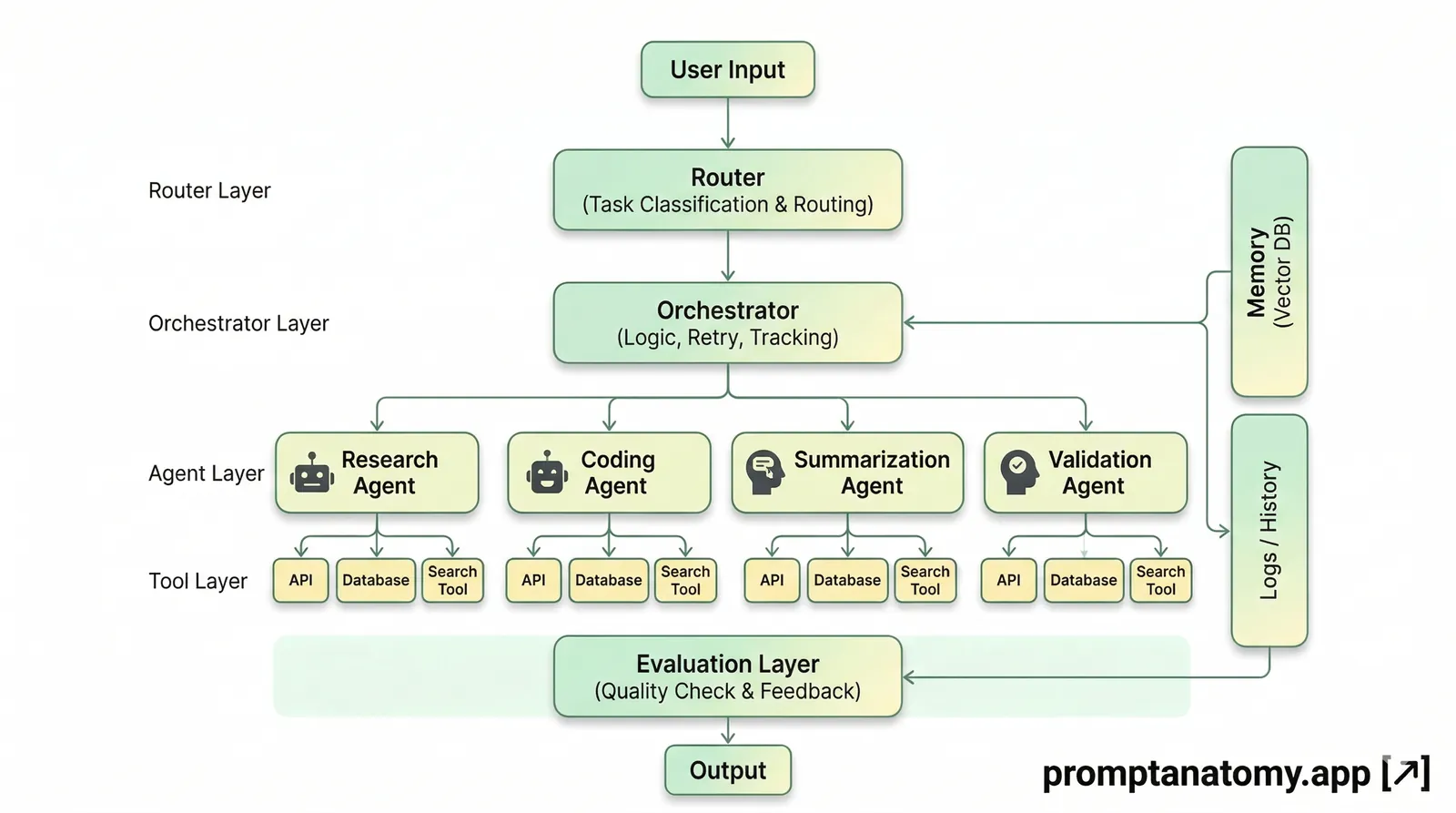
A coding agent cannot “watch” an MP4 the way an editor watches a monitor, and Remotion’s bundled ffmpeg binary omits standard diagnostic filters like freezedetect and signalstats. To make the QA • PASS / FAIL box in our architecture diagram real, we wrote scripts/motion-audit.mjs. It pipes the rendered MP4 out as 192x108 grayscale rawvideo buffers at 30fps and runs five binary checks in under two seconds.
- Gate 1 — Zero blank dips (
blankDips === 0): Counts frames where fewer than0.2%of pixels are lit (pixel > 28). This immediately caught a Remotion<Series>boundary bug at frames 322 and 715. Fading an outerAbsoluteFillexposed a 1-frame white flash instead of fading content over a persistentNavyBase(#0b1320). - Gate 2 — Maximum freeze ceiling (
maxFreezeS <= 2.0s): Measures consecutive frames with mean luma delta< 0.12outside the intentional end-card hold. A broken spring never leaves the viewer staring at a frozen screen. - Gate 3 — Zero hard cuts (
hardCuts === 0,diff <= 4): Flags any frame-to-frame luma spike above 4 gray levels outside declared scene boundaries. When a white browser card covering 47% of the viewport inAppInsideEnexited over a0.4sease, it spiked at~9 gray/frameand failed the gate. Replacing that ease with a1.3slinear fade ending0.4sbefore the scene boundary brought the transition inside spec. The same check also caught instant boolean border toggles (frame >= 96) and forced 8-frameinterpolate()ramps. - Gate 4 — Broadcast pixel format (
pix_fmt === "yuv420p"): CaughtsetVideoImageFormat("jpeg")inremotion.config.tsemitting full-rangeyuvj420p(bt470bg) and forced TV-range PNG frame rendering. - Gate 5 — Color space lock (
color_space === "bt709"): Verifies standard HD and 4K color metadata on every master file.
const gates = [
  { name: "no blank dips (<0.2% lit pixels)", ok: blankDips === 0, detail: `${blankDips} frames` },
  { name: "max freeze <= 2.0s (excl. end hold)", ok: maxFreezeS <= 2.0, detail: `${maxFreezeS}s` },
  { name: "no hard cuts (diff > 4)", ok: hardCuts === 0, detail: `${hardCuts} spikes` },
  { name: "pixel format yuv420p (TV range)", ok: probe.pix_fmt === "yuv420p", detail: probe.pix_fmt },
  { name: "color space bt709", ok: probe.color_space === "bt709", detail: probe.color_space },
];
Production practices: 20 JEV decision cards, brand sync, and the 6-still human gate
Fast agents create a new risk: rendering twenty mediocre videos just because rendering is cheap. Before we let video-agent build a catalog, we used promptanatomy.pro to generate 20 JEV Decision Cards that scored every candidate concept on value, evidence, and execution fit. Five concepts scored 0.95 to 1.0 and entered the Shoot lane (shoot_context, shoot_model, shoot_ground, shoot_cloud, shoot_inside). Three concepts stayed in Queue (queue_injection, queue_hooks, queue_mcp), while low-leverage ideas were explicitly Dropped (drop_vibe, drop_fourth, drop_help, drop_pro). We recorded those decisions in docs/video-production-plan.md as an append-only state ledger, applying the same discipline we teach in prompt regression testing in one week.
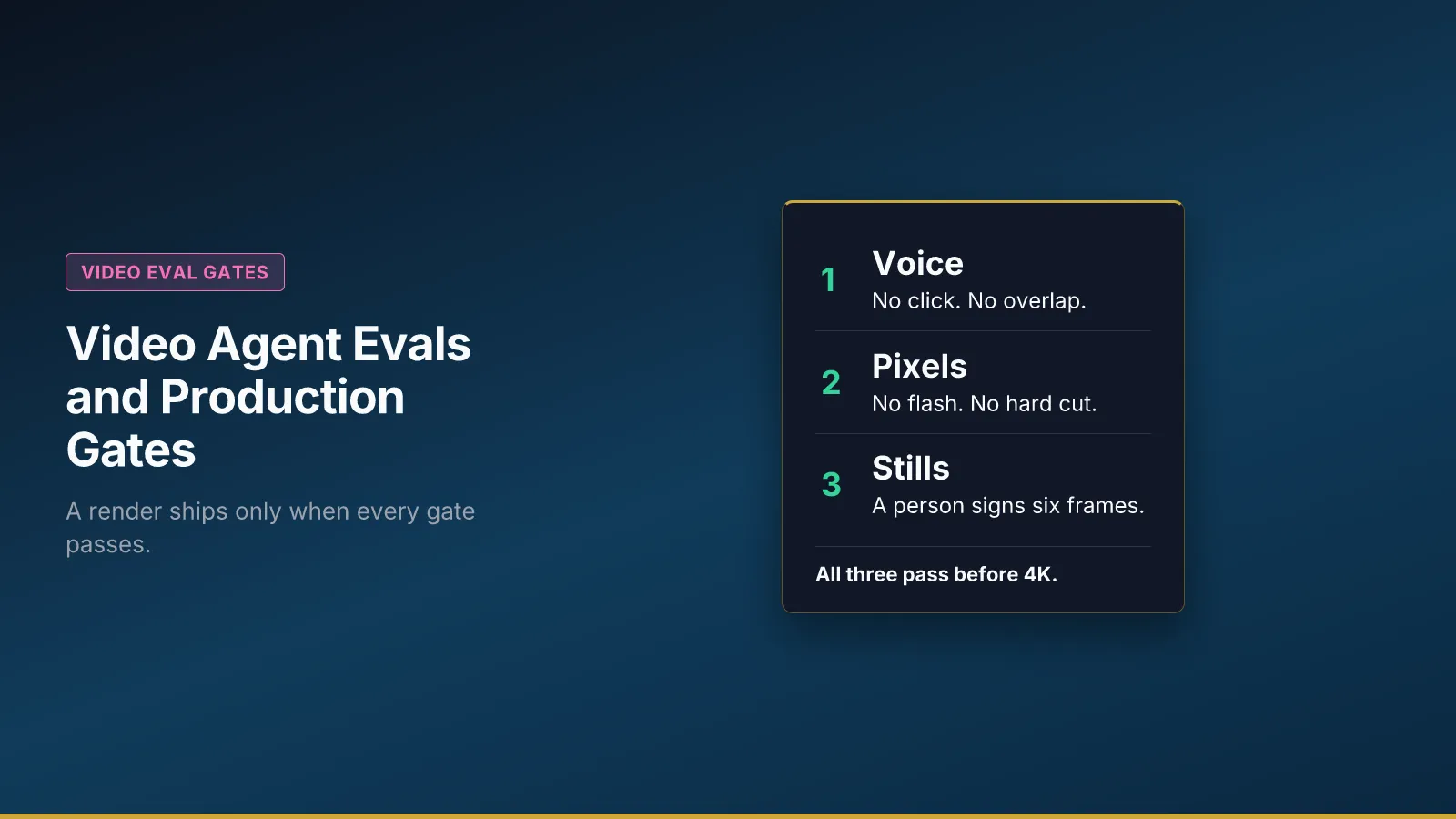
We also drew a hard line between automated gates and human judgment, matching handoff rules between humans and AI. Before running a --scale=2 4K export, the agent renders six diagnostic PNG stills (frames 75, 230, 400, 500, 650, 850) for human sign-off. Meanwhile, the Remotion project stays outside the public repository and the Vercel build, so Chromium and ffmpeg dependencies never bloat the web deploys described in shipping Prompt Anatomy.
| Maturity stage | Capability added to the Video Agent | Failure mode eliminated |
|---|---|---|
Stage 1 (v1 silent cuts) |
Remotion 30fps scenes + 44px type floor + #0b1320 / #cfa73a tokens |
Illegible mobile text and legacy #fbd304 color drift |
Stage 2 (v2 voiced masters) |
voiceover.mjs --check (<= 2.6 w/s) + 50ms PCM transient trim + motion-audit.mjs |
Scene audio overflows, -0.62 dBFS AAC clicks, and <Series> white flashes |
Stage 3 (v3 live UI + captions) |
scribe_v2 word-synced EN/LT captions + Playwright 2880x1800 live captures |
Static subtitles and screenshots showing unshipped authoring modules |
Stage 4 (Cross-repo .blog scale) |
The .app harness checks a second Remotion project (ContextArchitectureVo) rendered for .blog |
Single-repo lock-in; blog pillars now compile into companion films |
What traveled to this blog
The table is the growth. The move was the test. ContextArchitectureVo is composed in a small Remotion project that sits beside this blog, outside the public repository. The harness stayed in the promptanatomy.app checkout. The same voiceover.mjs --check budget and the same motion-audit.mjs gates ran against the .blog render before it was signed. Pacing and color did not get debugged a second time.
In 2019 the automated system was still a wish. This workstation now runs the Cursor session from Part 1. These checks are what that session reads before I sign a master. The channel at @MrBulletLt has about 17.9 million views. The views did not build the gates. The failed stems did.